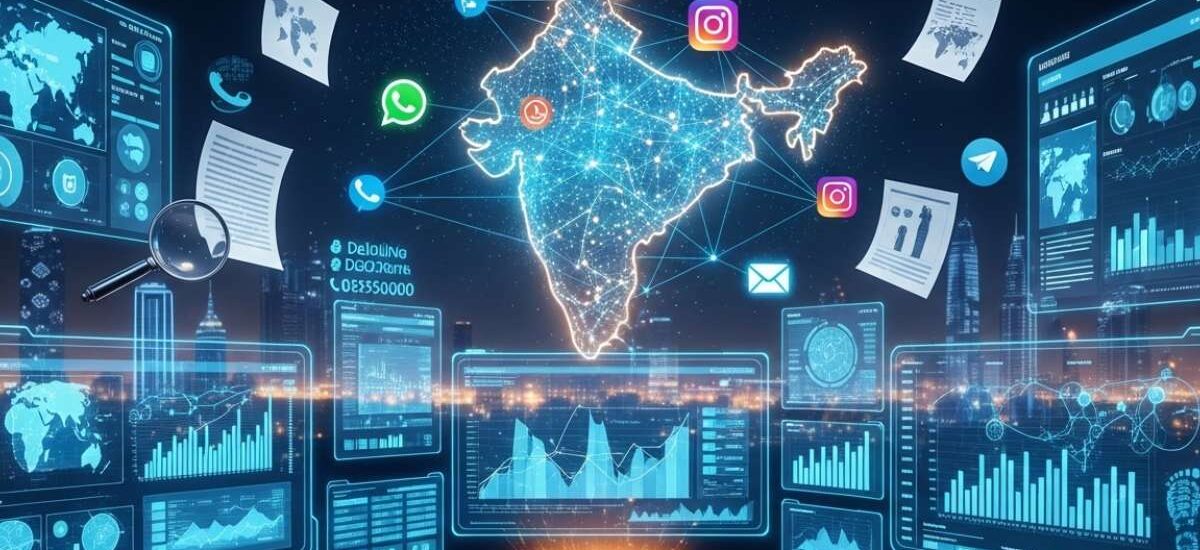
India is not just a large market. It is a layered, multilingual, mobile-first, and constantly shifting information environment. That makes it one of the most interesting places in the world for OSINT and SOCMINT, but also one of the most demanding. Anyone who has worked in this space knows the same thing very quickly: the signal is there, but it is buried under volume, language diversity, platform churn, and legal sensitivity.
OSINT in India is rarely a neat, linear exercise. It is more like fieldcraft. You move between open social content, public records, image clues, language markers, and behavioral patterns. You cross-check, verify, and discard noise. You adapt to the platform, the region, and the purpose of the investigation. That is why OSINT in the Indian context rewards patience, discipline, and a strong ethical compass.
India also sits at an important intersection. The country has a mature digital ecosystem, a huge social media footprint, a rapidly growing compliance environment, and a legal framework that treats digital records seriously. The Information Technology Act, 2000 gave legal recognition to electronic communication and electronic transactions, and the Bharatiya Sakshya Adhiniyam, 2023 now expressly recognizes electronic or digital records as admissible evidence, subject to the relevant provisions.
That combination matters. It means OSINT in India is not just about “finding things online.” It is about building a defensible workflow that respects privacy, preserves evidence, and stands up to scrutiny. The Digital Personal Data Protection Act, 2023 also sits at the center of this conversation because it governs digital personal data, applies to certain processing activities connected with India, and includes specific provisions on consent, legitimate uses, rights, and exemptions. The official text also makes clear that the Act commences in stages by notification rather than functioning as a single, static switch.
SOCMINT and OSINT in the Indian Context
In India, OSINT and SOCMINT often overlap, but they are not the same thing.
OSINT is the broader discipline. It pulls from public, observable, and lawfully accessible sources: websites, filings, records, images, documents, maps, public social posts, videos, registries, and metadata where available. SOCMINT is narrower and more social-media-centric. It focuses on public social content, network behavior, interaction patterns, hashtags, reposts, comments, communities, and platform signals.
In practice, Indian investigations often require both. A social post may point to a city, language, workplace, or contact pattern. A public record may then confirm a company name, property trail, or registration detail. A video may reveal a storefront, number plate, script style, or regional landmark. The strongest work comes from combining sources and checking every conclusion twice.
The Indian context makes that fusion especially important because many identities are blended across languages and platforms. A person may use one handle in English, another in Hindi, and a third in a regional language. A company may have a website in one script, a WhatsApp presence in another, and YouTube comments that reveal a completely different audience. The analyst who understands that texture has a real advantage.
Popular Platforms: Where OSINT Happens in India
Meta products: WhatsApp, Facebook, and Instagram
Meta products remain central to daily communication in India. WhatsApp is often used for small-group coordination, commerce, neighborhood alerts, and personal contact. Facebook still matters for community activity, local groups, business pages, and legacy identities. Instagram is a rich source for lifestyle clues, location patterns, affiliations, timestamps, and cross-platform handle reuse.
The value here is not only in the obvious content. The value is in consistency. Repeated usernames, repeated avatars, repeated bios, repeated story habits, and repeated contact patterns can build a very strong picture when combined carefully. In India, where many people use the same number or name across multiple channels, these patterns become especially useful.
YouTube
YouTube is often underestimated in OSINT work. In India, it is not just an entertainment platform. It is a search layer, a commentary layer, and in many cases a local-language news layer. Channels, community posts, thumbnails, captions, and comments can reveal affiliations and timing.
YouTube is also useful because it can preserve traces that other platforms remove quickly. A live-stream replay, a community post, or a comment thread can contain names, locations, or references that are hard to reconstruct later. For investigators, that makes archiving and note-taking essential.
Twitter/X
X is useful because it compresses public discourse into a fast-moving feed. It often surfaces breaking events, political narratives, corporate disputes, and local incident reporting. In India, it is especially valuable for understanding who is amplifying what, which communities are reacting, and how narratives spread across languages.
The challenge is speed. Content appears, gets reshared, gets deleted, and gets reinterpreted quickly. Good OSINT on X requires careful timestamping, screenshots, contextual reads, and a willingness to separate genuine signal from coordinated noise.
Telegram
Telegram is one of the most important platforms for high-volume, semi-closed, and broadcast-style sharing in the region. It is often used for community distribution, niche interest groups, activist circles, regional updates, and business-related channels. It can also be a place where rumors, leaks, and recycled media travel quickly.
For OSINT, Telegram is useful but fragile. Channels disappear, names change, messages are edited, and the same material may be mirrored elsewhere. The lesson is simple: capture context early and do not rely on a single snapshot if the material is important.
Regional platforms and regional-language ecosystems
India’s regional internet is a universe of its own. Local-language apps, state-focused communities, district-level Facebook groups, and regional creator ecosystems can be far more revealing than a national platform. This is where real field awareness matters.
A strong analyst knows that language is not just communication. It is a clue. Script choice, transliteration habits, slang, and the rhythm of a sentence can reveal origin, education, audience, or intended market. In Indian OSINT, regional literacy often matters as much as technical skill.
What to Look For: Emails and Phone Numbers for OSINT in India
Indian phone numbers
Indian mobile numbers are often a useful pivot point, but they should be handled carefully and lawfully. A number can appear in a bio, a business listing, a public document, a marketplace profile, or a contact card. The key is not to chase a number for its own sake. The key is to understand what the number connects to in the public record.
In India, contact traces often appear across different services and scripts. The same phone number may be tied to a business page, a delivery profile, a public complaint, or a visible account recovery trail. In a disciplined workflow, that number becomes one more corroborating detail rather than a shortcut to a conclusion.
The ethical line matters here. A private number should not be treated as an invitation to invade someone’s privacy. Use public, lawful, consent-based, or commercially authorized sources. Do not confuse “available somewhere online” with “free to exploit without restraint.”
Indian email addresses
Email addresses can be equally revealing. They may connect a person to a domain, a role, a company, a school, a forum, or an older digital identity. In the Indian context, email formats often expose whether a person uses a free provider, a business domain, a regional education domain, or an old account preserved for years.
That said, email-based inference should be treated as an indicator, not proof. A username may be reused, shared, inherited, or spoofed. Strong OSINT uses email as a lead, then validates it through corroboration. The best analysts never let a single identifier dominate the case.
Unique Challenges for OSINT in India
Disappearing data and platform instability
One of the biggest problems in India is how quickly digital material can disappear. Posts get deleted. Stories expire. Accounts vanish. Channels are renamed. Images get compressed and re-uploaded. Screenshots become the only surviving artifact.
This is why Indian OSINT rewards process. You need notes, timestamps, hashes where appropriate, and a clean chain of preservation. If the evidence is likely to matter later, capture it now and capture it properly.
Language and script barriers
India’s language diversity is one of its strengths and one of its OSINT complications. English, Hindi, Urdu, Bengali, Tamil, Telugu, Marathi, Kannada, Malayalam, Gujarati, Punjabi, and many other language communities all leave different digital signatures. Add transliteration and code-switching, and the challenge becomes more complex.
The analyst who can read context across scripts has a real advantage. Even when full fluency is not possible, recognizing place names, honorifics, slang, abbreviations, and language choice can save hours of false leads.
Legal and political red tape
India’s digital environment is not a free-for-all. Public information may still be legally sensitive depending on how it is collected, stored, shared, or reused. The right to privacy is a constitutional principle in India, following the Supreme Court’s recognition of privacy as a fundamental right. The DPDP Act also creates a formal data-protection framework for digital personal data, including notice, consent, rights, legitimate uses, and exemptions.
This is important for practitioners because OSINT success is not just about access. It is about admissibility, proportionality, and purpose. Collect what you are allowed to collect. Use what you are allowed to use. Preserve what you may need to justify later.
Legal and ethical considerations
The law matters, but so does professional ethics. In India, electronic records can have legal effect, and the evidence framework now explicitly addresses digital material. That increases the importance of provenance, documentation, and authenticity. If a screenshot, post, or recording may later be used in a dispute, the collection method and preservation method matter.
The practical rule is simple: public does not mean careless. Even when content is visible, responsible analysts avoid unnecessary exposure, avoid doxxing, avoid harassment, and avoid collecting more than is needed. That is the difference between professional OSINT and reckless data fishing.
Investigate OSINT in India with EINITIAL24
This is exactly where EINITIAL24 fits.
If your team needs OSINT training, EINITIAL24 can help build practical capability instead of just theory. That means teaching analysts how to work across Indian platforms, how to validate evidence, how to preserve records, how to read regional digital footprints, and how to maintain operational discipline in sensitive environments.
If you need services, EINITIAL24 can support investigations, workflow design, playbook creation, internal training programs, and custom OSINT process development. That is especially valuable for organizations that need repeatable methods rather than ad hoc effort.
If you need product development, EINITIAL24 can help design tools and systems tailored for Indian use cases: multilingual monitoring, evidence capture, lead triage, source mapping, and secure reporting. The strongest OSINT teams do not rely only on manual effort. They build systems that reduce noise and improve judgment.
In a market as complex as India, that combination is powerful. Training gives people skill. Services give organizations execution. Product development gives them scale. EINITIAL24 brings those three pieces together in one operational mindset.
How OSINT supports real work in India
OSINT is not only for investigators. In India, it has practical value across corporate security, due diligence, fraud detection, brand monitoring, supply-chain checks, recruitment screening, crisis response, and reputational risk management.
For corporate teams, OSINT can help identify impersonation, leaked brand assets, fake recruitment campaigns, and suspicious social amplification. For compliance teams, it can help map public exposure and identify weak links in a public-facing digital footprint. For journalists and researchers, it can help verify claims and identify narrative manipulation. For law enforcement and security professionals, it can help build situational awareness before escalation.
The best Indian OSINT programs do not chase glamour. They solve problems. They reduce uncertainty, speed up verification, and improve decisions.
Best methods for geolocating a photo taken within India
Geolocation in India often depends on a mix of visual literacy and local context. Road markings, language on signs, shop names, building styles, weather patterns, utility poles, religious architecture, vehicle registration clues, and terrain all matter.
The most reliable method is layered verification. Start broad, narrow by region, compare the visual evidence against known geography, and then confirm with at least one more independent clue. A single signboard is not enough. A single landmark is not enough. A converging set of signals is what matters.
This is where patience pays off. India is dense with visual similarity, but it is also rich in local markers. The analyst who learns to see small distinctions will outperform the one who hunts for dramatic reveals.
Using public records and property data responsibly
India has a growing set of digitized public records, including land and property-related resources in many states. That creates new possibilities for verification, but it also creates new responsibilities. Public access does not automatically authorize broad redistribution or misuse.
The right approach is targeted and minimal. Use public records to validate legitimate questions. Do not treat every public dataset as an invitation to compile people’s lives into a dossier. Precision is the goal, not excess.
OPSEC in Indian investigations
Operational Security, or OPSEC, is the discipline of protecting your own investigation from exposure, manipulation, and contamination. It matters in India as much as anywhere else, especially when cases involve public figures, corporate disputes, harassment campaigns, political narratives, or sensitive legal matters.
Good OPSEC means separating work identities from personal accounts, limiting unnecessary exposure, protecting credentials, documenting decisions, and avoiding careless reuse of handles or devices. It also means understanding that your own digital footprint can become part of the investigation.
That is why professional teams need discipline as much as tools. A strong analyst who leaks their own context is still vulnerable.
Are sock puppet accounts ethical?
They can be used in unethical ways, and that is where the caution starts.
In professional OSINT, transparency and proportionality should guide conduct. If an account is used to view public content for legitimate research, the ethical question is whether the use is necessary, lawful, and non-deceptive in a harmful way. In most professional settings, the safer approach is to minimize impersonation and avoid anything that crosses into manipulation, deception, or unauthorized access.
The cleanest policy is usually the best one: use authentic professional accounts where possible, and reserve alternative accounts only for clearly documented, lawful, and organization-approved purposes.
How to verify credibility on Indian social media
Verification is a habit, not a tool.
Start by checking whether the account has a stable history, repeated identity markers, and consistent behavior. Then compare the claim against independent sources, surrounding context, timestamps, and language patterns. Look for originality. Look for corroboration. Look for signs of recycling, baiting, or coordinated amplification.
A useful mindset is skepticism without cynicism. Not everything is false. Not everything is true. Your job is to separate the two carefully.
The technical difference between OSINT and SOCMINT
OSINT is the broader discipline that works across many public source types. SOCMINT is the social-media subset of OSINT that focuses on interactions, communities, narratives, and platform behavior.
The practical difference is important because social media is only one layer of the public web. A good analyst in India may start on a social platform, but the real work often continues in records, maps, documents, archived pages, public databases, image metadata, and local-language traces.
SOCMINT tells you how a story spreads. OSINT tells you how the story fits into the larger reality.
How Indian law enforcement agencies use OSINT
In India, law enforcement can use OSINT for situational awareness, threat monitoring, rumor tracking, event response, evidence building, and pattern recognition. The key is that any output eventually has to connect back to lawful process and evidentiary standards.
Because digital records have legal significance and the current evidence framework explicitly addresses electronic records, investigators must think about traceability from the start. Collection without preservation is wasted effort. Preservation without context is weak. The strongest work brings both together.
Can OSINT prevent corporate espionage in Indian firms?
Yes, and often more effectively than people expect.
A strong OSINT program can spot spoofed identities, suspicious recruitment activity, leaked credentials, fake vendor personas, counterfeit domains, abnormal social targeting, and signs that a competitor or threat actor is gathering intelligence about your organization. It can also expose how much of a company’s own footprint is publicly exploitable.
The value is not paranoia. The value is awareness. Once a firm understands its public exposure, it can reduce attack surface, harden processes, and train people better.
FAQs About OSINT in India
Is OSINT legal under India’s IT Act?
OSINT is not illegal just because it is OSINT. The legal question depends on the source, the method, the purpose, and what you do with the information. The IT Act, 2000 gives legal recognition to electronic records and electronic transactions, but it does not create a blanket permission to collect or misuse data in any way you like.
How does the DPDP Act 2023 affect OSINT practices?
It makes privacy and data handling more formal. The Act governs digital personal data, sets out obligations for processing, and gives individuals rights in relation to their data. It also contains exemptions and a staged commencement framework, so practitioners should not treat it as a casual background law.
Does searching public social media profiles violate privacy laws in India?
Not automatically. Public visibility is not the same as unrestricted permission. The lawful and ethical answer depends on context, purpose, and subsequent use. In India, privacy is constitutionally recognized, and digital personal data is now governed by a dedicated statutory framework.
Can OSINT findings be used as admissible evidence in Indian courts?
They can be, but admissibility depends on proper collection, preservation, and relevance. The Bharatiya Sakshya Adhiniyam, 2023 explicitly recognizes electronic or digital records and provides provisions for proving them. That means process matters as much as the content itself.
Is automated scraping of Indian government websites legally permitted?
That depends on the site, the data, the method, and any applicable restrictions. A public website is not automatically free from access controls, terms, or legal constraints. A careful practitioner checks authorization, volume, and sensitivity before automation.
What are the best free tools for OSINT in the Indian context?
Search engines, advanced search operators, map services, archive tools, metadata viewers, spreadsheets, and disciplined note-taking remain the foundation. The tool matters less than the workflow.
How can I verify the owner of an Indian mobile number using OSINT?
Use lawful, public, and consent-based sources only. Treat a number as a pivot for verification, not as a shortcut to expose a private person. The right method is to match the number against public business listings, public contact pages, or authorized records where legitimate purpose exists.
Are there specialized tools for monitoring Indian platforms like ShareChat or Koo?
There are tools that can help with social listening and multilingual tracking, but capability changes over time. The better question is whether the tool can handle local languages, account churn, deletion, and regional context.
How can I access digitized property and land records in India via OSINT?
Many state and local systems now publish digitized records or public-facing portals. The safe approach is to use official channels, verify state-specific rules, and avoid over-collection.
What are the best methods to geolocate a photo taken within India?
Combine visible text, architecture, terrain, weather, road style, vehicle indicators, and regional language clues. Then validate with at least one independent source. A single clue is rarely enough.
What is the current job scope for OSINT analysts in India?
The scope is broad. It spans corporate security, investigations, due diligence, journalism support, trust and safety, competitive intelligence, fraud detection, and threat monitoring. The strongest candidates are those who combine research rigor with judgment.
Which OSINT certifications are most recognized by Indian employers?
Recognition varies by employer. What matters most is whether the certification is backed by practical skill, ethical reasoning, and demonstrable output. A portfolio and a clear workflow often matter more than a badge alone.
How do Indian law enforcement agencies utilize OSINT for investigations?
They use it to improve awareness, connect public clues, and support evidence-driven workflows. The key is that digital material must still be handled in a way that supports legal standards.
What technical skills are essential for an OSINT career in India?
Search technique, source validation, multilingual reading, evidence capture, spreadsheet discipline, map literacy, and report writing. Automation is useful, but judgment is essential.
What is the average salary for an entry-level OSINT professional in India?
It varies widely by city, industry, skill depth, and whether the role is in security, consulting, media, or in-house risk. The market rewards people who can prove impact.
What is OPSEC and why is it vital for Indian investigators?
OPSEC is the discipline of protecting your work, identity, sources, and process from exposure or manipulation. It is vital because the investigator is often part of the attack surface.
Is the use of sock puppet accounts considered ethical in professional OSINT?
Only in tightly controlled and clearly justified circumstances, if at all. In most professional environments, minimizing deception is the safer and more defensible posture.
How do you verify the credibility of information found on Indian social media?
Cross-check the source, the timing, the language, the network, and the independent evidence. Do not trust a post just because it is popular.
What is the technical difference between OSINT and SOCMINT?
OSINT is the broader discipline; SOCMINT is the social-media subset. OSINT can include records, documents, maps, images, and websites. SOCMINT is focused on social behavior and public interaction on platforms.
How can OSINT be used to prevent corporate espionage within Indian firms?
By identifying public exposure, suspicious outreach, impersonation risks, leaked assets, and narrative manipulation before they become incidents. It is a defensive tool when used properly.
Closing thought
India rewards OSINT practitioners who are serious, patient, and ethical. The environment is too complex for shortcuts and too important for careless work. The analyst who succeeds here understands platforms, but also language. Knows the law, but also the human context. Collects data, but preserves judgment.
That is the standard EINITIAL24 is built around: practical training, operational services, and product development that help teams work smarter, safer, and more defensibly in the Indian context. In a space this demanding, capability is not a luxury. It is the whole game.