In 2026, digital crime is no longer a niche issue—it is a global reality. From cyber fraud and ransomware attacks to corporate espionage and mobile data theft, nearly every modern crime leaves a digital footprint. This is where Digital Forensics plays a critical role.
As organizations, governments, and law enforcement agencies struggle to keep pace with evolving cyber threats, the demand for skilled digital forensics professionals has never been higher. Digital forensics is no longer just about recovering deleted files—it is about uncovering truth in a world driven by data.
What is Digital Forensics?
Digital forensics is the scientific process of identifying, preserving, analyzing, and presenting digital evidence in a legally admissible manner. It involves investigating data from computers, mobile devices, servers, cloud platforms, networks, and even IoT systems.
Unlike traditional forensic science, digital forensics deals with volatile and easily alterable data. A single mistake can compromise evidence integrity. Therefore, investigators must follow strict protocols to ensure that digital evidence remains authentic and uncontaminated.
In 2026, digital forensics extends far beyond criminal investigations. It is now widely used in corporate investigations, cyber incident response, regulatory compliance, internal audits, intellectual property disputes, and national security operations.
Digital forensics professionals act as the bridge between technology and law, ensuring that digital facts can stand up in court and corporate review boards alike.
Who Is a Digital Forensics Investigator?
A Digital Forensics Investigator is a trained professional who specializes in uncovering, analyzing, and interpreting digital evidence related to cyber incidents, crimes, or policy violations.
These investigators may work with law enforcement agencies, private cybersecurity firms, multinational corporations, financial institutions, or government bodies. Their role often involves reconstructing events from digital traces left behind by users or attackers.
In practical terms, a digital forensics investigator might analyze a hacked server, recover deleted files from a mobile phone, trace email spoofing incidents, or identify insider threats within an organization.
At EINITIAL24, trainees are taught not only the technical skills but also the investigative mindset required to think like both a hacker and an analyst—an essential balance for modern digital forensics professionals.
Process of Digital Forensics Operations
Digital forensics follows a structured and methodical process to ensure accuracy and legal validity. Each step is critical and must be performed carefully.
Identification
The first step involves identifying potential sources of digital evidence. This may include computers, smartphones, external drives, cloud accounts, or network logs.
Investigators must determine what data is relevant to the case and ensure that it is properly isolated to prevent tampering or loss.
Preservation
Preservation focuses on protecting the integrity of digital evidence. This involves creating forensic images and using hash values to verify that the data has not been altered.
Improper handling at this stage can render evidence useless in legal proceedings. EINITIAL24 emphasizes strict chain-of-custody procedures during training.
Analysis
Analysis is where investigators examine the preserved data to uncover relevant information. This may include file recovery, timeline analysis, malware examination, or log correlation.
Advanced tools and techniques are used to extract hidden or encrypted data and reconstruct digital events.
Documentation
Every action taken during the investigation must be thoroughly documented. This documentation is essential for transparency and legal credibility.
Clear reporting ensures that findings can be understood by non-technical stakeholders such as lawyers, executives, or judges.
Presentation
The final step involves presenting findings in a clear, concise, and legally defensible manner. Investigators may testify in court or submit reports for corporate or regulatory review.
Digital Forensics Key Roles
Digital forensics offers a wide range of specialized roles, each focusing on different aspects of digital investigations.
Digital Forensics Analyst
These professionals analyze digital evidence using forensic tools. They focus on extracting, interpreting, and reporting data from devices and systems.
Incident Response Forensic Specialist
This role combines cybersecurity and forensics. Professionals respond to active cyber incidents and perform forensic analysis to understand attack vectors and damage.
Mobile Forensics Expert
Mobile forensics specialists focus on smartphones, tablets, and wearable devices. This role has grown significantly due to the widespread use of mobile technology.
Cloud Forensics Investigator
With cloud computing dominating enterprise environments, cloud forensics experts analyze data stored across cloud platforms and virtual infrastructures.
Legal and Compliance Forensics Consultant
These professionals support legal teams by ensuring that investigations comply with regulations and that evidence meets legal standards.
EINITIAL24 prepares students for all these roles by offering hands-on labs, real-world case simulations, and role-based learning paths.
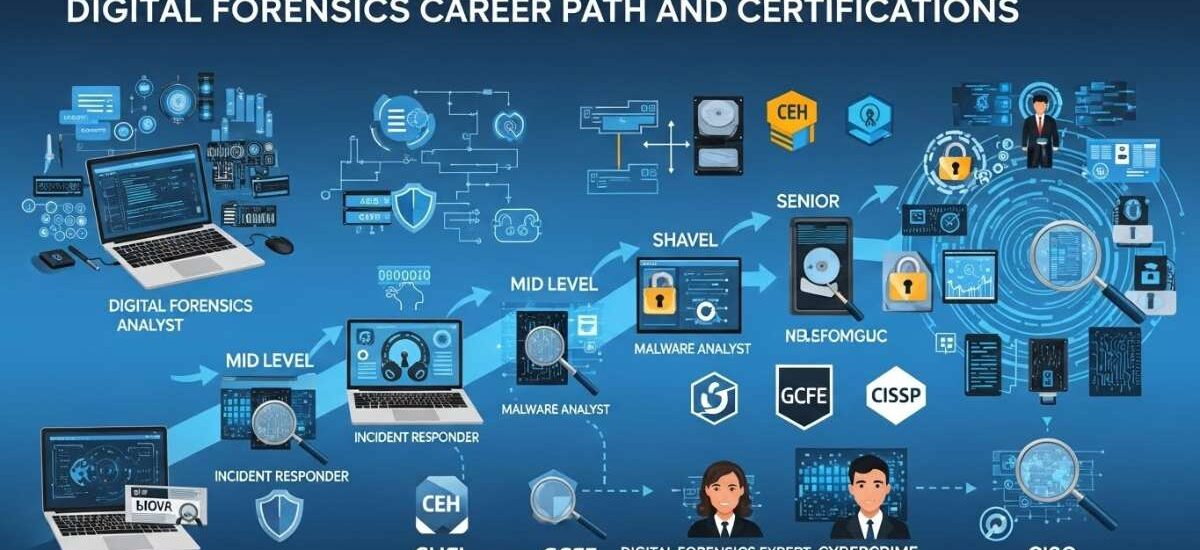
Digital Forensics Career Path
A career in digital forensics typically progresses through multiple stages, allowing professionals to specialize and grow over time.
Entry-Level Roles
Fresh graduates or career switchers often start as Junior Digital Forensics Analysts or Cybersecurity Trainees. These roles focus on basic evidence handling and tool usage.
Mid-Level Roles
With experience, professionals move into roles such as Forensics Analysts, Incident Responders, or Threat Investigators. These positions require deeper analytical skills and independent case handling.
Senior-Level Roles
Senior professionals may become Lead Forensic Investigators, Forensics Managers, or Consultants. They oversee investigations and mentor junior staff.
Expert and Leadership Roles
At the highest level, professionals work as Chief Information Security Officers (CISO), Forensic Architects, or Legal Expert Witnesses.
EINITIAL24 supports learners at every stage by offering beginner-to-advanced training modules aligned with real industry demands.
Why It’s a Good Career
Digital forensics is one of the most future-proof careers in technology. As long as digital systems exist, digital crime will follow.
The field offers job security, intellectual challenge, global opportunities, and competitive salaries. It also provides meaningful work, as investigators play a crucial role in justice, security, and trust.
Unlike many IT roles, digital forensics does not become obsolete quickly. Instead, it evolves, offering continuous learning and specialization opportunities.
With cybercrime expected to grow exponentially by 2026, digital forensics professionals trained by organizations like EINITIAL24 will remain in high demand worldwide.
Skills Needed for Digital Forensics
A successful digital forensics professional requires a balanced mix of technical and soft skills.
Technical Skills
Professionals must understand operating systems, file systems, networking concepts, and cybersecurity fundamentals. Familiarity with forensic tools and scripting is essential.
Analytical Thinking
Investigators must be able to analyze complex data sets, identify patterns, and reconstruct events logically.
Attention to Detail
Small details can make or break a case. Precision and patience are critical traits in forensic investigations.
Legal Awareness
Understanding laws, regulations, and evidence handling standards is crucial for ensuring legal admissibility.
Communication Skills
Investigators must communicate findings clearly to both technical and non-technical audiences.
EINITIAL24 integrates all these skills into its training programs, ensuring learners are job-ready from day one.
FAQs About Digital Forensics Career Path
Is digital forensics a good career?
Yes, digital forensics is an excellent career choice in 2026. It offers stability, growth, and relevance across industries, including law enforcement, corporate security, and consulting.
Is digital forensics well paid?
Digital forensics is well compensated, especially for professionals with certifications and hands-on experience. Salaries increase significantly with expertise.
How much money do digital forensics professionals make?
Entry-level professionals can earn competitive salaries, while experienced investigators and consultants earn substantially higher incomes depending on region and role.
What is the scope of digital forensics in India?
India has massive growth potential due to increasing cybercrime, digital banking, and regulatory requirements. Demand for trained professionals is rising rapidly.
Will AI take over digital forensics?
AI will assist digital forensics but will not replace human investigators. Human judgment, legal interpretation, and ethical decision-making remain essential.
Which is better, cybersecurity or digital forensics?
Both fields are important. Cybersecurity focuses on prevention, while digital forensics focuses on investigation. Many professionals combine both for greater career flexibility.
Is digital forensics difficult?
Digital forensics can be challenging, but with structured training and practical exposure—such as that provided by EINITIAL24—it becomes highly manageable.
What is the highest paid forensic job?
Senior forensic consultants, expert witnesses, and forensic architects are among the highest-paid professionals in the field.
Is digital forensics a stressful job?
Certain cases can be high-pressure, but many professionals find the work rewarding and intellectually satisfying.
What degree is best for digital forensics?
Degrees in computer science, cybersecurity, IT, or digital forensics are ideal. However, practical training and certifications from institutes like EINITIAL24 are equally important.
Why Choose EINITIAL24 for Digital Forensics Training?
EINITIAL24 stands out as a trusted name in digital forensics and cybersecurity training. The company focuses on practical, industry-aligned learning, not just theory.
Students receive hands-on experience with real tools, real scenarios, and expert mentorship. Training programs are designed to align with global certifications and job market needs in 2026.
Whether you are a student, working professional, or career switcher, EINITIAL24 provides the skills, confidence, and support needed to succeed in digital forensics.
Final Thoughts
Digital forensics is not just a career—it is a mission to uncover truth in a digital world. As cyber threats grow more sophisticated, the need for skilled investigators will only increase.
With the right training, mindset, and guidance from EINITIAL24, you can build a successful, respected, and future-proof career in digital forensics in 2026 and beyond.
If you are ready to step into one of the most in-demand tech careers of the decade, digital forensics is the path forward—and EINITIAL24 is the place to begin.