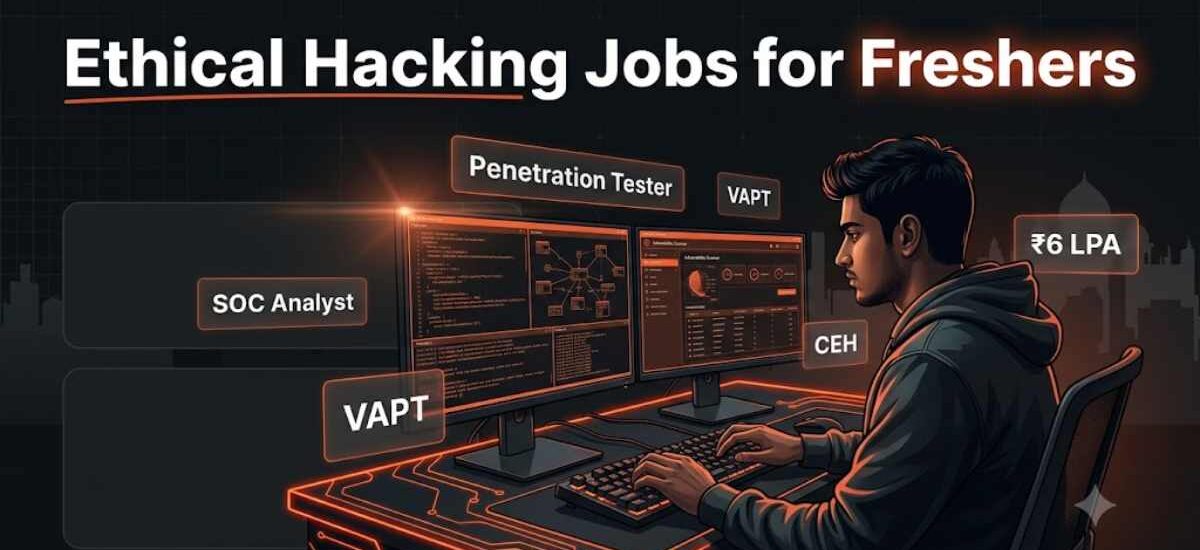
Introduction to Ethical Hacking Jobs for Freshers
The world is more connected than ever — and more vulnerable than ever. Every day, thousands of cyberattacks hit businesses, governments, hospitals, and individuals. Hackers are not slowing down. That is exactly why ethical hackers are in such massive demand right now.
If you are a fresher looking to build a career in cybersecurity, you have landed at the right place at the right time. Ethical hacking is not just a trending job title. It is one of the most future-proof, high-paying, and purpose-driven careers you can choose in 2026.
India is facing a cybersecurity talent shortage of over 1.5 million professionals. Companies across every industry are hiring — from IT giants to startups to banks to government agencies. And the best part? You do not need years of experience to get started. With the right skills, the right certifications, and practical hands-on training, freshers are breaking into this field every single month.
In this guide, you will learn everything you need to know about ethical hacking jobs for freshers — including what roles are available, what companies are hiring, what salaries to expect, what skills you need, and exactly how to land your first cybersecurity job in India.
Whether you are from Delhi, Noida, Gurgaon, or anywhere else in India, this guide is for you.
Table of Contents
- What Are Ethical Hacking Jobs?
- Is Ethical Hacking a Good Career for Freshers?
- Can Freshers Get Ethical Hacking Jobs?
- Top Ethical Hacking Jobs for Freshers
- Ethical Hacking Salary for Freshers in India
- Companies Hiring Ethical Hackers
- Skills Required to Get Ethical Hacking Jobs
- Best Certifications for Freshers
- Ethical Hacking Roadmap
- How to Get Your First Ethical Hacking Job
- Common Interview Questions
- Resume Tips for Freshers
- Ethical Hacking Career Path
- Challenges Freshers Face
- Mistakes to Avoid
- Why Choose EINITIAL24 for Ethical Hacking Training?
- Ethical Hacking Jobs in Delhi NCR
- Final Thoughts
- FAQs
What Are Ethical Hacking Jobs?
Ethical hacking is the practice of legally breaking into systems, networks, and applications to find vulnerabilities before malicious hackers do. An ethical hacker, also called a penetration tester or white-hat hacker, is hired by an organization to test its security posture and report weaknesses.
Ethical hacking jobs involve a wide range of responsibilities. These include scanning networks for open ports and vulnerabilities, testing web applications for security flaws, performing social engineering tests, writing detailed vulnerability reports, and recommending fixes to the security team. It is not just about hacking — it is about thinking like an attacker so you can protect the organization more effectively.
This field sits under the broader umbrella of cybersecurity, which also includes roles in SOC (Security Operations Center), incident response, threat intelligence, digital forensics, and compliance. When you start your career in ethical hacking, you are entering one of the most dynamic and respected fields in the entire technology industry.
Industries that hire ethical hackers include banking and finance, healthcare, e-commerce, government agencies, defense, IT services, telecom, and insurance. Basically, any organization that operates digitally needs ethical hackers — and that is almost every organization today.
Is Ethical Hacking a Good Career for Freshers?
Absolutely. Ethical hacking is one of the best career choices for freshers in 2026 — and here is why.
Job Security is Extremely High. Cyber threats are increasing every year. The demand for skilled cybersecurity professionals will not reduce anytime soon. In fact, it is going to grow. This means your job is never going to become obsolete.
Salaries Are Above Average. Even as a fresher, ethical hackers earn significantly more than professionals in many other IT roles. As you gain experience, your salary grows rapidly.
Remote Work Opportunities Exist. Many cybersecurity roles can be done remotely. This opens up global opportunities for skilled Indian professionals.
Career Growth Is Fast. In ethical hacking, skill matters more than years of experience. If you are good at what you do, you can move up quickly.
It Is a Purpose-Driven Career. Ethical hackers protect people. They stop real criminals from stealing data, money, and privacy. That sense of purpose makes this career more than just a job.
Global Demand Keeps Rising. Not just in India — companies in the USA, UK, UAE, Singapore, and Australia are all hiring cybersecurity professionals. Your skills have global value.
Can Freshers Get Ethical Hacking Jobs?
Yes, freshers absolutely can get ethical hacking jobs — but you need to be strategic about it.
The biggest myth is that you need years of experience to get into cybersecurity. That is not true. What companies actually want is proof that you can do the work. And you can demonstrate that even without work experience, if you take the right approach.
The key is to focus on practical skills over theoretical knowledge. Employers want freshers who can work with tools like Burp Suite, Nmap, and Wireshark. They want people who understand how web vulnerabilities work, how networks are configured, and how attackers think.
Another great route is through internships. Many companies offer cybersecurity internships for freshers, and these often convert into full-time roles. An internship also gives you real-world experience that you can put on your resume.
Building a portfolio is equally important. Solving Capture The Flag (CTF) challenges, completing labs on platforms like Hack The Box or TryHackMe, and doing bug bounty research all show employers that you have practical skills.
Certifications also help bridge the experience gap. Entry-level certifications signal to employers that you have been trained and tested on core skills. We will talk more about which certifications are best for freshers later in this guide.
Top Ethical Hacking Jobs for Freshers
Here are the most common entry-level roles available to freshers in the cybersecurity and ethical hacking space:
| Job Role | Average Salary (Fresher) | Experience Required |
|---|---|---|
| SOC Analyst Level 1 | ₹3.5 – ₹5.5 LPA | 0–1 Year |
| Junior Penetration Tester | ₹4 – ₹7 LPA | 0–2 Years |
| Security Analyst | ₹3.5 – ₹6 LPA | 0–1 Year |
| Vulnerability Assessment Analyst | ₹4 – ₹6.5 LPA | 0–2 Years |
| Information Security Analyst | ₹3.5 – ₹6 LPA | 0–1 Year |
| Security Operations Analyst | ₹3 – ₹5.5 LPA | 0–1 Year |
| Cyber Security Associate | ₹3 – ₹5 LPA | 0–1 Year |
| Incident Response Analyst | ₹4 – ₹7 LPA | 0–2 Years |
| Security Consultant (Junior) | ₹4.5 – ₹8 LPA | 1–2 Years |
| GRC Analyst | ₹3.5 – ₹5.5 LPA | 0–1 Year |
Each of these roles has a slightly different focus. SOC Analysts monitor security alerts in real time. Penetration Testers actively try to break into systems. GRC Analysts focus on governance, risk, and compliance. As a fresher, any one of these can serve as your entry point into the cybersecurity world.
Ethical Hacking Salary for Freshers in India
Salary in cybersecurity depends heavily on your location, skills, and the type of company you join. Here is a city-wise breakdown for freshers:
| City | Average Fresher Salary (LPA) |
|---|---|
| Delhi | ₹3.5 – ₹6 LPA |
| Gurgaon | ₹4 – ₹7 LPA |
| Noida | ₹3.5 – ₹6.5 LPA |
| Bengaluru | ₹4 – ₹8 LPA |
| Hyderabad | ₹3.5 – ₹7 LPA |
| Pune | ₹3.5 – ₹6.5 LPA |
| Mumbai | ₹4 – ₹7.5 LPA |
| Chennai | ₹3 – ₹6 LPA |
These numbers grow significantly with experience. A professional with just 2–3 years in penetration testing or SOC analysis can earn ₹10–15 LPA. Senior professionals and red teamers can earn ₹20–40 LPA or more.
If you are in Delhi NCR — which includes Noida, Gurgaon, Faridabad, and Ghaziabad — the cybersecurity job market is booming. With so many IT companies, MNCs, and government organizations headquartered in this region, freshers here have some of the best job opportunities in India.
Companies Hiring Ethical Hackers
Ethical hackers are needed across multiple types of organizations. Here is a broad look at who is hiring:
Large IT Services Companies like TCS, Infosys, Wipro, Tech Mahindra, Capgemini, and HCLTech have dedicated cybersecurity practices. They often hire freshers for SOC analyst roles and security associate positions. These companies provide good exposure to enterprise security environments.
Global Consulting and Advisory Firms such as Accenture, IBM, Deloitte, EY, and Capgemini regularly hire for penetration testing, vulnerability assessment, and GRC roles. They work with large clients across industries, giving you broad exposure.
Product and Technology Companies are some of the most exciting places to work in cybersecurity. Companies focused on network security, cloud security, and endpoint protection hire ethical hackers to test their own products and help customers stay secure.
Indian Cybersecurity Startups are growing rapidly. Many startups focused on threat intelligence, vulnerability management, and security operations are scaling fast and actively hiring freshers who show strong practical skills.
Banking and Finance Sector is one of the largest employers of cybersecurity professionals. Banks, insurance companies, and fintech firms all have dedicated security teams.
Government and Defense is another major employer. Organizations under CERT-In, DRDO, NIC, and various state governments are investing heavily in cybersecurity.
Skills Required to Get Ethical Hacking Jobs
Skills are your currency in this field. Here are the core skills you need to build as a fresher:
Networking Fundamentals form the foundation of everything. You need to understand how data travels across networks, what TCP/IP means, how DNS and DHCP work, and what subnetting involves. Without networking knowledge, you cannot understand how attacks happen.
Linux is the operating system of cybersecurity. Kali Linux is the most widely used distribution for ethical hacking. You need to be comfortable with the Linux command line — navigating directories, managing files, running scripts, and using built-in tools.
Windows and Active Directory are critical because most corporate environments run on Windows. Understanding how Active Directory works, how user authentication happens, and how attackers exploit Windows environments is a must for penetration testers.
Burp Suite is the most widely used tool for web application security testing. Learning Burp Suite well is one of the fastest ways to become employable as a fresher.
Nmap is used for network scanning and reconnaissance. Knowing how to use Nmap to discover hosts, open ports, and running services is a basic skill every ethical hacker needs.
Wireshark lets you capture and analyze network traffic in real time. It is used in network troubleshooting, intrusion detection, and security analysis.
Metasploit is the most popular exploitation framework. Understanding how to use it responsibly for testing systems is a valuable skill.
OWASP Top 10 is the standard list of the most critical web application security risks. Every ethical hacker who wants to work in web security must know these vulnerabilities inside and out.
API Security and Web Security are increasingly important as more applications are built using APIs. Understanding how REST APIs work and how they can be exploited is a growing area of demand.
Python Basics help you automate tasks, write custom tools, and parse data more efficiently. You do not need to be a software developer, but basic Python scripting is a strong advantage.
Bash and PowerShell scripting are used for automating tasks in Linux and Windows environments respectively.
Report Writing is a skill many freshers overlook. After a penetration test, you need to write a clear, structured report that both technical and non-technical stakeholders can understand. Good report writing sets you apart.
Best Certifications for Freshers
Certifications validate your knowledge and give employers confidence in your skills. Here are the best ones for freshers:
eJPT (eLearnSecurity Junior Penetration Tester) is the best starting certification for absolute beginners. It is entirely practical and tests your ability to perform real penetration testing tasks. This is ideal if you are just starting out.
CompTIA Security+ is a globally recognized certification that covers a broad range of security concepts. It is vendor-neutral and respected by employers worldwide, especially if you are targeting multinational companies.
CEH (Certified Ethical Hacker) is one of the most well-known certifications in India. Many job postings mention CEH as a preferred qualification. It is more theory-heavy than practical, but the brand recognition is strong.
Google Cybersecurity Certificate is a beginner-friendly certification that teaches foundational cybersecurity skills. It is affordable and a good starting point for those completely new to the field.
PNPT (Practical Network Penetration Tester) is an excellent practical certification for aspiring penetration testers. It involves a real-world assessment and report writing, making it highly valued by employers.
CompTIA CySA+ is a mid-level certification focused on security analytics and SOC operations. It is ideal if you are targeting SOC Analyst roles.
CRTA and CPTS are advanced practical certifications that are highly respected in the red teaming and penetration testing community. These are goals to work toward as you build your skills.
For absolute beginners, start with eJPT or Google Cybersecurity Certificate. Then progress to Security+ or CEH. As you gain more experience, aim for PNPT or CPTS.
Ethical Hacking Roadmap
Here is a step-by-step roadmap to go from zero to job-ready as an ethical hacker:
Step 1: Learn Networking. Start with the basics — OSI model, TCP/IP, DNS, DHCP, routing, subnetting. This is the foundation everything else builds on.
Step 2: Learn Linux. Get comfortable with Kali Linux. Practice command-line navigation, file permissions, process management, and basic scripting.
Step 3: Learn Python. Pick up basic programming skills in Python — loops, functions, file handling, and network automation.
Step 4: Study Web Security. Learn how HTTP works, how web applications are structured, and what common vulnerabilities like SQL Injection, XSS, and CSRF look like.
Step 5: Master the OWASP Top 10. Go through each of the ten most critical web application vulnerabilities in depth. Understand how they work and how to test for them.
Step 6: Learn Burp Suite. Practice intercepting and modifying web requests. Learn how to use the Scanner, Repeater, Intruder, and other modules.
Step 7: Practice in Labs. Use intentionally vulnerable applications like DVWA, WebGoat, and Metasploitable to practice your skills safely.
Step 8: Solve CTFs. Capture The Flag competitions help you develop problem-solving skills and expose you to different types of security challenges.
Step 9: Build Your Portfolio. Document your CTF writeups, lab solutions, and personal projects on GitHub. This shows employers what you are capable of.
Step 10: Apply for Internships. Internships give you real-world experience and often lead directly to full-time roles.
Step 11: Apply for Jobs. With your skills, certifications, and portfolio in place, start applying for entry-level cybersecurity roles.
How to Get Your First Ethical Hacking Job
Getting your first job is the hardest step — but it is absolutely achievable. Here is what actually works:
Build a Strong Resume. Your resume should highlight your certifications, labs, projects, and any internship experience. Focus on practical skills rather than just listing courses completed.
Optimize Your LinkedIn Profile. Recruiters actively search LinkedIn for cybersecurity talent. Add your certifications, skills, and a clear headline that mentions what you do. Connect with people working in the cybersecurity industry.
Create a GitHub Profile. Upload your CTF writeups, scripts, and security tools here. A well-maintained GitHub profile is powerful proof of your skills.
Participate in Bug Bounty Programs. Finding real vulnerabilities in companies’ bug bounty programs and getting acknowledged (even without monetary rewards) is strong resume material.
Play Hack The Box and TryHackMe. These platforms have beginner-friendly labs that teach real penetration testing skills. Document your progress and share your achievements.
Do Meaningful Projects. Set up a home lab with virtual machines. Practice testing networks, exploiting vulnerable systems, and writing reports. Document everything.
Network Actively. Attend cybersecurity meetups, webinars, and conferences. Join online communities. Many jobs are filled through referrals and networking rather than job postings.
Prepare Thoroughly for Interviews. Research the company, practice technical questions, and be ready to walk through your projects and explain your thinking.
Common Interview Questions
Here are frequently asked interview questions for fresher ethical hacking and cybersecurity roles:
- What is the difference between a vulnerability, a threat, and a risk?
- Explain the TCP three-way handshake.
- What is the OWASP Top 10? Name at least five vulnerabilities.
- What is SQL Injection and how would you test for it?
- What is Cross-Site Scripting (XSS)? What are the different types?
- What is the difference between symmetric and asymmetric encryption?
- What is a firewall? What is the difference between a stateful and stateless firewall?
- Explain what a VPN is and how it works.
- What is the difference between IDS and IPS?
- What is a man-in-the-middle attack? How can it be prevented?
- What tools have you used for penetration testing?
- What is a port scan? What does Nmap do?
- What is Active Directory and why is it important in enterprise security?
- What is the difference between a black box, white box, and grey box penetration test?
- Tell me about a security project or CTF challenge you have completed.
- What is the CVE database and how do you use it?
- What is a zero-day vulnerability?
- How would you approach a web application penetration test?
- Why do you want to work in cybersecurity?
- Where do you see yourself in five years in the cybersecurity field?
Prepare detailed answers for each of these. Practice explaining technical concepts in simple language — this shows you actually understand what you are talking about.
Resume Tips for Freshers
A well-crafted resume can open doors even without work experience. Here is what to include:
Projects Section should be prominently featured. Describe the tools you used, what you tested, and what you found. Even lab-based projects matter.
Certifications should be listed with the issuing organization and the date completed. Put the most recognized ones first.
Internships — even short ones — should be included with a clear description of what you did and what tools you worked with.
GitHub Link should be on your resume. Recruiters do click on it.
LinkedIn Profile URL should also be included. Make sure your profile is complete and professional.
CTF Achievements are worth listing if you have placed well or solved particularly challenging challenges.
Technical Skills Section should list all the tools and technologies you know — Burp Suite, Nmap, Wireshark, Metasploit, Kali Linux, Python, etc.
Keep It Clean and Concise. One to two pages is ideal. Use simple formatting. Avoid generic objective statements — replace them with a short professional summary that highlights what you bring to the table.
Ethical Hacking Career Path
This field offers one of the most exciting career progression paths in all of technology:
SOC Analyst (Level 1 → Level 2 → Level 3) is often the entry point. You monitor alerts, investigate incidents, and respond to threats. As you grow, you take on more complex investigations and eventually mentor junior analysts.
Security Analyst involves analyzing vulnerabilities, reviewing logs, and supporting incident response efforts.
Penetration Tester is where many ethical hackers aspire to be. You actively test systems and applications for security weaknesses and write reports for clients.
Senior Penetration Tester handles complex engagements, leads teams, and manages client relationships.
Red Team Operator simulates full-scale, realistic cyberattacks against organizations to test their defenses holistically.
Security Consultant advises organizations on their security strategy, helps implement security programs, and assesses risk.
Security Architect designs secure systems and infrastructure at a strategic level.
CISO (Chief Information Security Officer) is the top of the ladder — responsible for the entire security posture of an organization.
The path from SOC Analyst to CISO typically takes 10–15 years, but skilled professionals can climb faster. The key is to keep learning, keep practicing, and take on challenging roles.
Challenges Freshers Face
It is important to be honest about the challenges so you can prepare for them:
No Work Experience is the most common hurdle. Most job postings ask for 1–2 years of experience even for “entry-level” roles. The solution is to substitute experience with practical projects, labs, and certifications that demonstrate you can do the job.
Lack of Practical Skills is a problem for freshers who have only watched tutorials without actually practicing. The solution is to set up a home lab, complete platforms like TryHackMe or Hack The Box, and work through structured labs regularly.
Weak Networking Fundamentals trip up many candidates in interviews. The solution is to go back to basics — study networking properly before moving on to advanced topics.
No Portfolio leaves recruiters with nothing to evaluate. Start building your GitHub profile and documenting your work today.
Interview Fear is real but manageable. Practice mock interviews regularly. Prepare for both technical and behavioral questions. The more you practice, the more confident you become.
Fake Certifications and Courses are a growing problem. Many institutes sell certificates without actually teaching usable skills. The solution is to choose institutes with a proven track record, industry-expert trainers, and practical lab environments.
Mistakes to Avoid
Freshers in cybersecurity often make the same mistakes. Being aware of them helps you avoid wasting time:
Only Watching Videos without practicing is the number one mistake. Watching someone else hack is nothing like doing it yourself. Always follow along with hands-on labs.
Skipping Networking Fundamentals leaves huge gaps in your knowledge. You cannot understand attacks and defenses without understanding how networks work.
Ignoring Linux is a critical error. Most cybersecurity tools run on Linux. If you are not comfortable with the command line, you will struggle in the field.
Not Practicing Consistently is what separates people who get jobs from people who do not. Set aside dedicated time every day to practice.
Having No GitHub Profile means you have no proof of your work. Start uploading your projects, writeups, and tools.
Having No Portfolio is similar — you need tangible evidence of your skills beyond a certificate.
Skipping Internships is a mistake. Even unpaid internships or part-time cybersecurity work provides experience that is invaluable on your resume.
Copying Reports from online sources instead of writing your own is a serious professional and ethical mistake. Report writing is a skill — develop it yourself.
Why Choose EINITIAL24 for Ethical Hacking Training?
If you are serious about building a career in ethical hacking, the training you choose matters enormously. At EINITIAL24, we do not just teach you cybersecurity — we prepare you to work in the real world.
Industry Expert Trainers. Our trainers are working professionals with real-world experience in penetration testing, SOC operations, and security consulting. They bring practical knowledge from actual engagements into the classroom.
Hands-On Practical Labs. Theory alone will not get you a job. Our training is lab-intensive, with dedicated practice environments where you work with the same tools used in the industry — Burp Suite, Metasploit, Wireshark, Nmap, Kali Linux, and more.
Live Projects. We give students exposure to real-world scenarios through live project-based learning. You will not just complete exercises — you will solve actual security challenges.
Internship Opportunities. EINITIAL24 offers internship placements to eligible students, giving you real work experience that strengthens your resume before you even complete your course.
Resume Building Support. Our team helps you craft a cybersecurity resume that stands out — one that highlights your skills, projects, certifications, and achievements effectively.
Mock Interviews. We conduct regular mock interview sessions so you walk into real interviews prepared and confident. Our trainers give you honest, constructive feedback so you improve with every session.
Placement Assistance. We actively assist students in getting placed through our growing network of hiring partners, referrals, and job support. Your career does not end when your course does — we stay with you.
Career Guidance. Not sure which role to target? Which certification to pursue first? We provide personalized career counseling to help you build the right roadmap for your specific goals.
Small Batch Sizes. We keep our batches small on purpose. Every student gets individual attention. If you have a doubt, it gets answered — not buried in a crowd of 50 students.
Offline + Online Training Options. Whether you prefer learning in person at our South Delhi training center or attending sessions online from wherever you are, we have flexible options for you.
Flexible Timings. We offer morning, evening, and weekend batches so you can learn without disrupting your existing schedule.
Dedicated Doubt Sessions. Questions that come up outside class hours get answered. We have doubt-clearing sessions to ensure no concept remains unclear.
Local Support for Delhi NCR Students. If you are in South Delhi, Noida, Gurgaon, Faridabad, or anywhere in the NCR, our physical presence means you get direct access to trainers, alumni, and a growing local cybersecurity community.
Ready to Start Your Cybersecurity Career?
📞 Book a Free Demo Class — See exactly how we teach before you commit. No pressure, no hard sells.
📄 Download Course Brochure — Get the full syllabus, certification details, and fee structure.
💬 Talk to a Career Counselor — Get personalized advice on which course is right for you.
📱 WhatsApp Now — Reach us instantly for any queries.
🏢 Apply for Internship — Start building real-world experience while you learn.
Ethical Hacking Jobs in Delhi NCR
Delhi NCR is one of the most active cybersecurity job markets in India. Here is what the hiring landscape looks like across the region:
South Delhi has a growing number of IT companies, financial services firms, and startups. Areas like Saket, Nehru Place, Malviya Nagar, and Greater Kailash are hubs of business activity where cybersecurity professionals are in demand.
Nehru Place is famous as Delhi’s IT hub and many IT services and security firms operate in this area. Freshers targeting local jobs should definitely explore opportunities here.
Noida is home to hundreds of IT companies and software firms. Sectors like Sector 62, Sector 16, and Sector 18 house many MNCs and Indian IT companies that regularly hire cybersecurity professionals.
Gurgaon is perhaps the most active corporate hub in NCR. With major MNCs, fintech companies, and cybersecurity consultancies operating from Cyber City, DLF Phase, and Udyog Vihar, Gurgaon offers some of the best-paying cybersecurity jobs in the region.
Ghaziabad and Faridabad are growing IT markets, with more companies setting up operations here. Freshers from these areas can find opportunities locally as well as in the broader NCR.
Greater Noida is seeing rapid growth in its IT and business park zones. Companies here are increasingly building internal security teams.
Whether you are from Devli, Khanpur, Sangam Vihar, Kalkaji, Govindpuri, Tughlakabad, Badarpur, Chhatarpur, Mehrauli, or Lajpat Nagar — if you have the right skills, opportunities in Delhi NCR are genuinely within reach. EINITIAL24’s physical presence in South Delhi makes us the ideal training partner for students and working professionals across the entire NCR region.
Final Thoughts
Ethical hacking is not an elite career reserved for geniuses or people with computer science degrees from top universities. It is a skill-based field where dedication, consistent practice, and the right training take you further than any college certificate.
If you are starting from scratch, do not let that intimidate you. Every professional you see in a senior cybersecurity role today was once exactly where you are now — a beginner trying to figure out where to start.
Here is what matters most:
Focus on practical skills, not just theoretical knowledge. Build a portfolio that proves you can do the work. Practice consistently — daily, if possible. Start with internships or junior roles and grow from there. Stay curious and keep learning, because this field evolves fast.
The cybersecurity industry needs more good people. The companies are waiting. The salaries are compelling. The career growth is real. And the purpose — protecting people and organizations from harm — is genuinely meaningful.
The only thing standing between you and your first ethical hacking job is the decision to start. Make that decision today.
FAQs About Ethical Hacking Jobs for Freshers
1. Can freshers get ethical hacking jobs in India?
Yes, freshers can absolutely get ethical hacking jobs in India. With the right certifications, practical skills, a portfolio, and internship experience, freshers are hired regularly for entry-level roles like SOC Analyst, Junior Penetration Tester, and Security Analyst.
2. What is the salary of an ethical hacker fresher?
Fresher ethical hackers in India typically earn between ₹3 LPA and ₹7 LPA depending on location, skills, and the company. Cities like Gurgaon, Bengaluru, and Mumbai tend to offer higher starting salaries.
3. Which companies hire ethical hackers?
Large IT services companies, global consulting firms, product companies, cybersecurity startups, banking and finance organizations, and government agencies all hire ethical hackers. The demand spans virtually every industry.
4. Is CEH enough to get a job?
CEH helps, especially because many Indian employers recognize the brand. However, CEH alone is not sufficient. Practical skills demonstrated through labs, projects, and hands-on experience matter just as much — if not more.
5. Do I need a degree for ethical hacking?
A degree is not always mandatory. Many companies prioritize skills and certifications over formal degrees. However, having a degree in IT, Computer Science, or a related field can give you an advantage during initial screening.
6. Can I become an ethical hacker after 12th?
Yes. After 12th, you can pursue a diploma or course in cybersecurity and ethical hacking. With the right training and certifications, you can enter the field without a bachelor’s degree, though getting a degree alongside training is recommended.
7. Which city has the most ethical hacking jobs in India?
Bengaluru has the highest volume of cybersecurity jobs in India. However, Delhi NCR (including Noida and Gurgaon), Mumbai, Hyderabad, and Pune also have very strong demand.
8. What skills do recruiters expect from freshers?
Recruiters look for networking fundamentals, Linux proficiency, knowledge of tools like Burp Suite and Nmap, understanding of OWASP Top 10, web application security concepts, and the ability to write clear reports.
9. Is Python mandatory for ethical hacking jobs?
Python is not strictly mandatory for all roles, but it is a strong advantage. Basic Python scripting skills help you automate tasks, write custom tools, and solve problems more efficiently.
10. Can I get an ethical hacking job without experience?
Yes, but you need to substitute experience with practical projects, lab work, CTF participation, bug bounty reports, and certifications. Internships also help bridge the experience gap.
11. How long does it take to become job-ready?
With focused, consistent learning and hands-on practice, most students become job-ready in 6 to 12 months. The timeline depends on how much time you dedicate each day and the quality of your training.
12. Which certification is best for beginners?
The eJPT (Junior Penetration Tester) and CompTIA Security+ are the best certifications for absolute beginners. For those targeting Indian companies specifically, CEH is also widely recognized.
13. What is the difference between a SOC Analyst and a Penetration Tester?
A SOC Analyst monitors systems and alerts for security incidents in real time and responds to threats. A Penetration Tester actively tries to break into systems and applications to find vulnerabilities before attackers do. SOC is more defensive (Blue Team), while penetration testing is more offensive (Red Team).
14. Are remote ethical hacking jobs available for freshers?
Yes, remote opportunities exist, especially for roles like security analyst and vulnerability assessment. However, most companies prefer freshers to start in-office or hybrid setups initially.
15. How can I prepare for an ethical hacking interview?
Study networking fundamentals, web security concepts, and the OWASP Top 10 thoroughly. Practice using tools like Burp Suite and Nmap. Solve CTF challenges and document your solutions. Practice explaining technical concepts clearly and confidently.
16. What projects should I include in my cybersecurity portfolio?
Include CTF writeups, home lab configurations, vulnerability assessment reports from intentionally vulnerable applications, network scanning projects, and any bug bounty findings. Document everything clearly.
17. Are internships necessary before applying for ethical hacking jobs?
Not strictly necessary, but they are a significant advantage. An internship provides real-world experience, references, and resume material that sets you apart from other freshers.
18. What industries hire ethical hackers the most?
Banking and financial services, IT services, e-commerce, healthcare, telecom, government agencies, and cybersecurity consultancies are the biggest employers of ethical hackers.
19. Where can I find ethical hacking jobs in Delhi NCR?
Jobs in Delhi NCR can be found through job portals, LinkedIn, company career pages, cybersecurity meetups, and through the placement networks of reputed training institutes like EINITIAL24, which is based in South Delhi.
20. Which ethical hacking training institute offers placement assistance in Delhi?
EINITIAL24 in South Delhi offers comprehensive ethical hacking training with dedicated placement assistance, resume building support, mock interviews, internship opportunities, and career guidance for students across Delhi NCR.