Introduction About OSINT Risks in Ai Toys
Christmas has always been a season of joy, surprise, and new gifts. In recent years, however, the gifts under the tree have changed. Alongside dolls, robots, talking plush toys, and interactive learning companions, there is now a new category of present entering homes everywhere: AI toys.
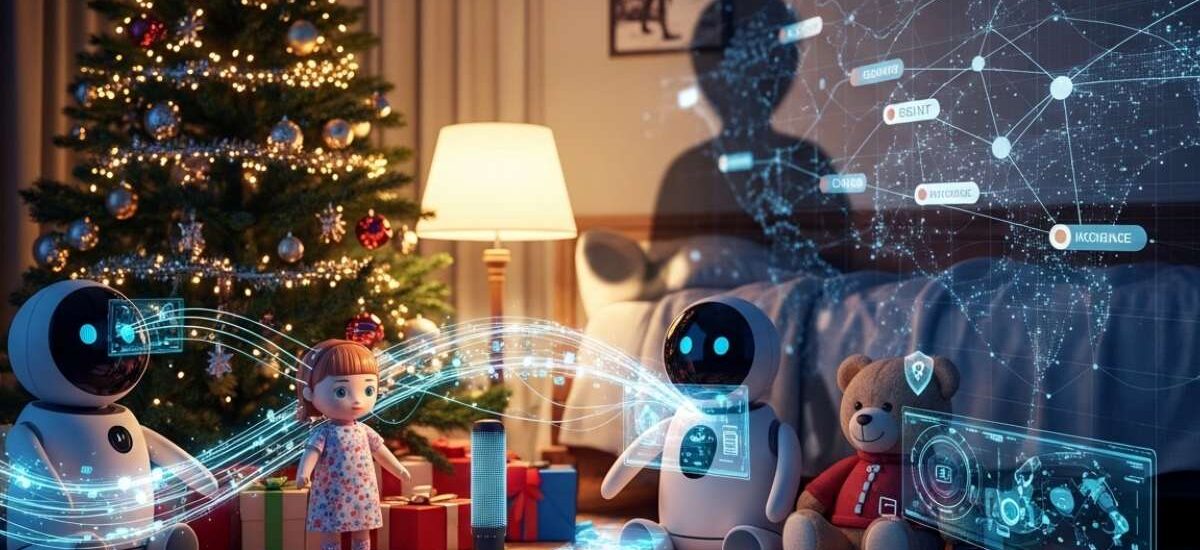
These toys are not ordinary playthings. They listen, respond, learn, and sometimes connect to the internet. They can answer questions, tell stories, recognize voices, and personalize conversations based on how a child interacts with them. To a child, that feels magical. To a parent, it can look educational and modern. But to a cybersecurity professional or OSINT analyst, it raises a very important question: what data is being collected, where does it go, and who might be able to use it?
That is where OSINT, or Open Source Intelligence, comes into the discussion. OSINT is the process of gathering and analyzing information from publicly available or accessible sources. AI toys may not look like intelligence tools, but they can create digital footprints, metadata trails, cloud records, and behavioral patterns that become valuable sources of information. In some cases, they can also create privacy and security risks inside the home.
In this we will explain how AI toys work, why they matter from an OSINT perspective, how they can expose families to risk, and what can be done to stay safe. It also explores how investigators may use data from AI toys in ethical OSINT operations, and why the future of this technology needs both innovation and caution.
For organizations that want deeper capability in this area, EINITIAL24 offers training, workshops, services, and product development support focused on OSINT, digital risk awareness, and modern intelligence workflows.
What Are AI Toys?
AI toys are smart toys that use artificial intelligence to interact with users in a more dynamic and personalized way. They may include voice recognition, natural language processing, cloud-based learning, app connectivity, sensors, microphones, cameras, or Bluetooth and Wi-Fi access.
A traditional toy reacts in a simple way. Press a button, and it makes a sound. Pull a string, and it repeats a phrase. An AI toy behaves differently. It can hold a conversation, adapt responses, and sometimes remember previous interactions. It may recognize different voices, respond to repeated phrases, and tailor its behavior to a child’s habits or preferences.
Examples include smart dolls, educational robots, interactive pets, and story-based devices that respond to speech. Some are built to support learning. Others are designed for companionship. A few are marketed as “safe digital friends” for children.
The challenge is that these toys often depend on connected systems. Their intelligence is not fully inside the toy. Much of the actual processing happens in the cloud. That means data leaves the toy, travels over the internet, and may be stored or analyzed elsewhere.
That is the first major concern.
How Do AI Toys Work?
To understand the risk, it helps to understand the architecture.
AI toys usually operate through a chain of technologies. First, the toy collects input. That input might be a child’s voice, a command, a question, a movement, or environmental data gathered through sensors. Then the toy sends that data to a backend system, often through a companion app or direct internet connection.
The backend system may process the data using AI models. Those models interpret speech, classify intent, generate replies, and update the experience. The response is then sent back to the toy or the app.
This process creates convenience and personalization, but it also creates a digital trail.
That trail can include:
- voice recordings,
- transcripts,
- device identifiers,
- timestamps,
- user profiles,
- account information,
- Wi-Fi details,
- location-related clues,
- and interaction logs.
In an OSINT context, these details may become extremely useful. Even if the toy is not designed to expose information publicly, the combination of cloud storage, app connectivity, and user behavior can create a rich source of metadata.
What feels like play can quietly become data.
Not Just for Kids: The OSINT Risks of AI Toys
Although AI toys are usually bought for children, the risks do not stop with the child. In many homes, the toy becomes part of a connected environment that includes phones, tablets, home Wi-Fi, smart speakers, smart locks, cameras, and cloud accounts. This makes the toy part of a larger digital ecosystem.
From an OSINT perspective, the risks are broader than many people realize.
1. Personal information exposure
Children and family members may reveal names, routines, school names, favorite places, pet names, or even details about vacations and schedules while interacting with a toy. If that information is stored insecurely or linked to a broader account ecosystem, it becomes useful intelligence.
2. Behavioral profiling
A toy that learns preferences also learns behavior. It may know when a child usually plays, what topics they ask about, how they speak, and whether they are alone or with family. Over time, these patterns can reveal habits and routines.
3. Household mapping
Repeated conversations can expose information about the household. A child might mention room names, family members, travel plans, or whether parents are home. A toy with location services or app-based syncing can strengthen those clues.
4. Attack surface expansion
Any connected toy is another endpoint inside the digital home. If the device is poorly secured, it may become a pathway for unauthorized access, account compromise, or broader network probing.
5. Long-term data retention
Some companies retain voice data, transcripts, and app interactions longer than families expect. If that data is stored in the cloud, it can persist beyond the toy’s physical life.
The risk is not just that a toy can “hear.” The real issue is that it can record, store, sync, and reveal context.
Cloud Storage and Syncing
One of the most important things to understand about AI toys is that they rarely operate alone. They are usually connected to cloud services.
This cloud model is attractive for manufacturers because it allows them to improve functionality, push updates, personalize experiences, and collect usage analytics. For users, it means smoother performance and more features. For security and privacy, it means more exposure.
Cloud syncing can create several concerns.
First, data is often transmitted outside the local home environment. Once it leaves the toy, the user no longer fully controls where it goes or how long it stays there.
Second, cloud systems may store data in ways that users cannot easily inspect. Families may not know whether recordings are kept, whether transcripts are created, or whether account activity is linked across devices.
Third, if the cloud account is compromised, the attacker may gain access to stored interactions, profile data, or device controls. In some cases, that could expose private conversations or location-related information.
From an OSINT standpoint, cloud syncing can be a goldmine of context. From a family safety standpoint, it is a reminder that convenience often has a price.
Community Features
Some AI toys include social or community features. These may allow children or families to share achievements, interact with other users, join online communities, or connect toy behavior to shared content libraries.
These features can sound harmless, but they create additional exposure.
Community features may unintentionally reveal:
- usernames,
- child profile details,
- age ranges,
- locations,
- photos,
- activity patterns,
- or device usage habits.
If profiles are public, even partially, OSINT practitioners can sometimes gather more information than the user intended to share. A toy account tied to a broader digital identity may help connect platforms, usernames, family accounts, and content preferences.
For parents, the issue is not only who can see the content today. It is also how that content might be archived, indexed, mirrored, or reused later.
Anything public can become searchable. Anything searchable can become intelligence.
Data Breaches
No connected device is completely immune to breach risk. AI toys are no exception.
A breach may expose:
- account details,
- email addresses,
- passwords or password hashes,
- voice transcripts,
- customer support data,
- device identifiers,
- or profile information.
If attackers obtain this data, they can use it for phishing, credential stuffing, identity fraud, or social engineering. In the context of OSINT, breached data can also become a source of correlation. A single leaked email address or username may help connect multiple services, reveal buying patterns, or identify family structures.
For example, a breached toy account linked to a parent’s email might be cross-referenced with other public data points. That could reveal more than the original owner expected.
This is why breach intelligence matters. It is not only about what is stolen. It is also about how that stolen information can be combined with other sources to build a fuller intelligence picture.
Weak Privacy Protection
Privacy protection in the toy market is uneven.
Some manufacturers take privacy seriously. Others design for engagement first and security second. That difference matters.
Weak privacy protection may show up in several ways:
- unclear terms of service,
- vague data retention policies,
- limited parental controls,
- poor authentication,
- lack of encryption,
- no obvious delete function,
- or minimal transparency about third-party data sharing.
This is especially concerning for toys aimed at children, because children cannot be expected to understand the full implications of cloud-connected play. In many cases, parents are making decisions without complete technical visibility.
From an OSINT perspective, weak privacy protection increases the amount of potentially recoverable information. From a home security perspective, it increases the risk of misuse, exploitation, and exposure.
A toy should not become a data liability. But if privacy is treated as an afterthought, that is exactly what can happen.
Playing with OSINT: How Can Investigators Use OSINT from AI Toys?
It is important to handle this topic responsibly. OSINT is not about invading privacy or misusing information. It is about using lawful, ethical, publicly available, or legitimately accessible information for analysis, awareness, investigation, and risk assessment.
AI toys may generate data that investigators can use in legitimate contexts such as cyber defense, fraud analysis, incident response, corporate investigations, or consumer protection research.
Pivoting
A small data point can lead to larger discoveries. A username, account handle, or unique device tag may be used to pivot into other connected sources. That can help investigators identify patterns, associated accounts, or linked infrastructure.
Metadata analysis
Metadata often tells a story that the visible content does not. Timestamps, device IDs, file sizes, communication timing, app usage patterns, and location-related clues can reveal a lot about behavior and system design.
Long-form interactions
Unlike short social media posts, AI toy conversations may be long, repeated, and emotionally rich. These interactions can reveal routines, preferences, family structures, language style, and contextual clues useful for behavioral analysis.
Breach intelligence
If a toy platform suffers a breach, the exposed material may become a source for threat hunting, attribution support, or security awareness research. Even a small leak can reveal larger systemic weaknesses.
Still, there is a line that must not be crossed. Ethical OSINT respects privacy, follows the law, and avoids unnecessary harm. Just because data is accessible does not mean it should be exploited.
How Parents and Families Can Reduce Risk
There are practical steps families can take to reduce exposure without abandoning technology entirely.
Start by reading the privacy policy and app permissions before purchase. It sounds tedious, but it is one of the most effective ways to understand what the toy does with data.
Choose toys from manufacturers that are transparent about:
- what they collect,
- why they collect it,
- how long they store it,
- and how users can delete it.
Disable features that are not needed. If the toy does not require location services, turn them off. If voice history can be deleted, use that option regularly. If the toy has a companion app, keep it updated and use a strong password.
It is also smart to isolate smart toys on a separate Wi-Fi network when possible. That way, if one device has a security flaw, the whole home network is less exposed.
Finally, talk to children in simple language. They do not need a lecture on privacy law. They do need to know that toys are not the place to share full names, addresses, school names, passwords, or family travel plans.
The best defense is awareness.
How Organizations Should Think About AI Toys
AI toys are not only a consumer issue. They also matter to schools, child safety advocates, product teams, cybersecurity professionals, and investigators.
Organizations working in these spaces should consider:
- supply chain review,
- secure-by-design requirements,
- privacy-by-design requirements,
- threat modeling for connected toys,
- awareness training for staff and families,
- and incident response planning.
This is where structured capability matters. Understanding AI toys from both a technical and intelligence perspective helps teams make better decisions.
EINITIAL24 supports organizations through training, workshops, services, and product development focused on OSINT, digital intelligence, privacy awareness, and practical cybersecurity thinking. Whether the need is capability building, operational support, or custom development, the goal is the same: help teams work smarter, safer, and with better visibility in an increasingly connected world.
The Future of OSINT and AI Toys
The next generation of AI toys will likely be more capable, more personalized, and more integrated with the smart home. That means better experiences, but also more data creation.
Future toys may become more conversational, emotionally adaptive, and context-aware. They may recognize mood, environment, and family routines more accurately than current devices. That kind of advancement can be impressive, but it also increases the amount of intelligence generated in the home.
For OSINT professionals, this means more data sources, richer context, and more opportunities for lawful analysis. For families, it means more responsibility. For regulators and manufacturers, it means privacy and security cannot remain optional.
The future will reward companies that design with trust in mind.
FAQs About OSINT and AI Toys
Q: What are AI toys?
AI toys are smart interactive toys that use artificial intelligence, voice recognition, sensors, cloud services, or machine learning to respond to users and adapt over time.
Q: What are the primary OSINT risks associated with AI toys?
The main risks include data collection, behavioral profiling, metadata exposure, cloud syncing, and accidental leakage of personal or household information.
Q: Can AI toys be used for surveillance or to access a home network?
Poorly secured AI toys can create privacy and security exposure. In some cases, a compromised device may provide a pathway into broader home systems.
Q: Are AI toys secure?
Security varies widely by manufacturer. Some are reasonably protected, while others may have weak controls, poor transparency, or outdated security practices.
Q: What kind of information might an AI toy collect?
An AI toy may collect voice data, transcripts, account data, device identifiers, preferences, usage patterns, and sometimes location-related information.
Q: How can I protect my children from AI toy risks?
Review permissions, disable unnecessary features, use strong passwords, update software, isolate devices on separate networks, and teach children not to share personal information.
Q: What is OSINT?
OSINT means Open Source Intelligence. It is the practice of collecting and analyzing information from publicly available or legitimately accessible sources.
Q: How is AI changing OSINT investigations?
AI helps analysts process more data, detect patterns faster, summarize large content sets, and automate repetitive tasks while keeping human judgment in the loop.
Q: What are the ethical concerns of using AI in OSINT?
Ethical concerns include privacy invasion, misuse of data, overcollection, bias, and the risk of making decisions without enough human oversight.
Q: Will AI replace OSINT analysts?
No. AI will support OSINT analysts, not replace them. Human context, verification, ethical judgment, and investigative intuition remain essential.
Conclusion
AI toys are more than holiday entertainment. They are connected devices that can generate, store, and transmit data. That makes them exciting, useful, and, in some cases, risky.
For parents, the message is simple: enjoy the innovation, but do not ignore the privacy implications. For investigators, the message is equally clear: AI toys may become meaningful OSINT sources, but they must be approached ethically and responsibly. For businesses and institutions, the opportunity lies in security education, stronger design, and better awareness.
This Christmas, the safest gift is not just a smart toy. It is informed decision-making.
And for teams looking to build practical capability in OSINT, digital intelligence, workshops, training, and product development, EINITIAL24 is positioned to help organizations turn awareness into action.