Quick Answer
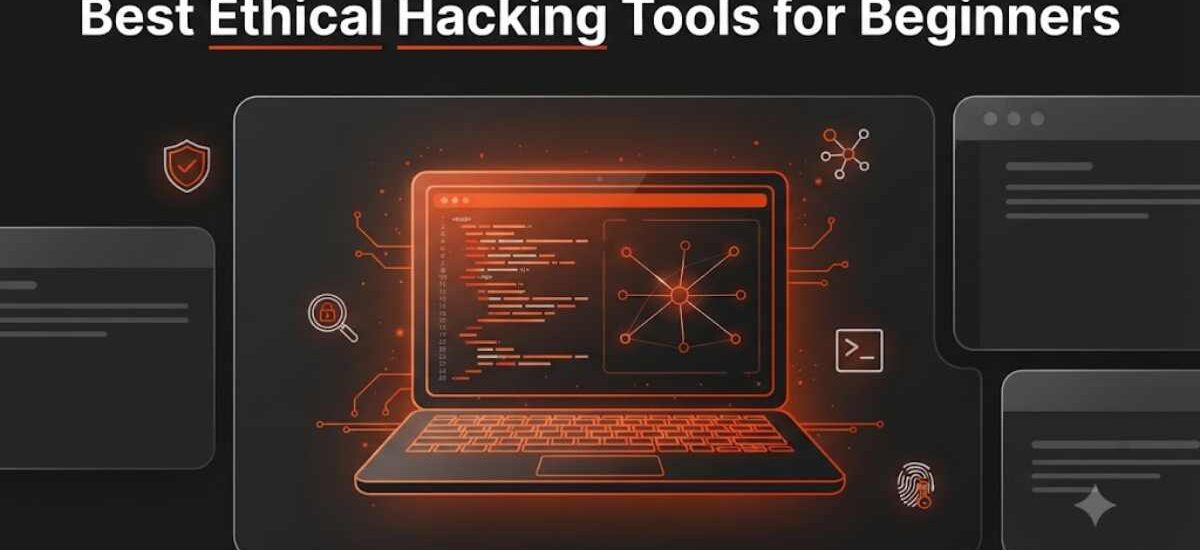
The best ethical hacking tools for beginners in 2026 are Kali Linux, Nmap, Wireshark, Burp Suite, Metasploit, Hydra, John the Ripper, SQLMap, and Gobuster. These tools help you scan networks, test web applications, crack passwords, and understand real-world vulnerabilities. Learning them with structured, practical training — like the programs offered at EINITIAL24 — is the fastest way to turn theory into a job-ready skillset.
Introduction to Ethical Hacking Tools for Beginners
Cybersecurity is no longer a “nice to have” skill. It’s a necessity. Every bank, hospital, government department, e-commerce platform, and startup in India is sitting on data that someone, somewhere, wants to steal. That’s exactly why ethical hacking has become one of the most in-demand career paths in the country today.
If you’ve ever typed “how to become an ethical hacker” into Google at 1 AM, wondering whether this field is really for you — you’re not alone. Thousands of students, graduates, and working professionals across India ask the same question every single day. And the honest answer is: yes, you can learn ethical hacking, even if you’re starting from zero.
This guide is built for absolute beginners. We’re going to walk through what ethical hacking actually is, why it matters so much right now, and which tools you need to know to get started. We’ll also cover installation steps, basic commands, career paths, expected salaries in India, and how to learn all of this in a structured, practical way rather than jumping between random YouTube videos and half-finished tutorials.
Whether you’re a student in Delhi trying to figure out your career direction, a commerce graduate looking for a switch into tech, or a working professional who wants to upskill into cybersecurity — this article is written for you. And if you want to skip the trial-and-error phase entirely, EINITIAL24 offers hands-on, mentor-led ethical hacking training designed specifically for people starting from scratch.
Let’s get into it.
What You’ll Learn
✔ Beginner-friendly explanation of ethical hacking
✔ Step-by-step guide to the top tools
✔ Practical, real-world examples
✔ Career opportunities and salary expectations
✔ Common mistakes beginners make
✔ How EINITIAL24’s training can get you job-ready faster
What is Ethical Hacking?
Ethical hacking is the practice of legally breaking into computers, networks, and applications to find security weaknesses before criminals do. Think of it like hiring someone to try every door and window in your house to see which ones are unlocked — except the “house” is a company’s entire digital infrastructure.
The person doing this is called an ethical hacker, or sometimes a “white hat” hacker. Unlike a malicious hacker, everything they do is authorized, documented, and reported back to the organization so the vulnerabilities can be fixed.
Ethical hacking isn’t about writing random scary-looking code in a dark room. It’s a structured, methodical process — reconnaissance, scanning, gaining access, maintaining access, and finally, reporting. Beginners often assume it’s all about “hacking passwords.” In reality, it’s closer to being a digital detective who understands systems well enough to know exactly where they can break.
If this sounds intimidating, don’t worry. Every expert ethical hacker today started exactly where you are — not knowing the difference between a port scan and a packet sniffer. The gap between “beginner” and “professional” is simply structured practice, and that’s something you can build over a few months with the right guidance.
Why is Ethical Hacking Important?
Industry Demand
Cyberattacks in India have grown at an alarming pace over the last few years. Ransomware, phishing, data leaks, and banking fraud are no longer rare headlines — they’re a weekly occurrence. Every organization, from a five-person startup to a public sector bank, now needs people who understand how attackers think.
This has created a massive demand-supply gap. There simply aren’t enough trained ethical hackers to fill the open positions in India right now, which means beginners who invest in this skill today are stepping into a job market that badly needs them.
Real-World Use
Ethical hacking isn’t a theoretical subject confined to textbooks. It’s used every single day to:
- Test whether a company’s website can be broken into
- Check if an internal network can be accessed by an outsider
- Simulate phishing attacks to train employees
- Audit mobile apps before they go live
- Assess cloud infrastructure for misconfigurations
Companies That Need This Skill
IT services firms, banks, fintech startups, e-commerce platforms, healthcare providers, and government agencies all actively hire for security roles. Many companies also run “bug bounty” programs, paying independent researchers to find flaws in their systems — which means you don’t even need a traditional job to start earning from these skills.
Cybersecurity Careers
Ethical hacking is often the entry point into a much larger cybersecurity career tree — Security Operations Center (SOC) analyst, penetration tester, red team operator, security consultant, and more. It’s one of the few tech fields where a beginner with genuine skill can outpace someone with a fancier degree but no hands-on experience.
How Does Ethical Hacking Work?
Every ethical hacking engagement generally follows five stages. Understanding this flow will help everything else in this guide make sense.
Step 1: Reconnaissance — Gathering information about the target: domain names, IP addresses, employee details, technologies used. This is done without touching the target directly, using publicly available information.
Step 2: Scanning — Actively probing the target to find open ports, running services, and potential entry points. This is where tools like Nmap come into play.
Step 3: Gaining Access — Attempting to exploit the vulnerabilities discovered during scanning. This might involve weak passwords, outdated software, or misconfigured settings.
Step 4: Maintaining Access — In real attacks, hackers try to stay inside a system undetected. Ethical hackers simulate this to show how long an intrusion could go unnoticed.
Step 5: Reporting — The most important step. Every finding is documented with evidence, severity ratings, and recommended fixes, then handed over to the organization.
We’ll add screenshots and visual walkthroughs of each stage in our extended hands-on labs during EINITIAL24’s practical training sessions, where you actually perform these steps in a safe, legal lab environment instead of just reading about them.
Key Takeaways
- Ethical hacking is a legal, structured process used to find and fix security weaknesses before criminals exploit them.
- India’s cybersecurity job market has far more openings than trained professionals, creating strong opportunities for beginners.
- Tools like Kali Linux, Nmap, Wireshark, Burp Suite, and Metasploit form the foundation every beginner should learn first.
- You don’t need a computer science degree to start — dedication, curiosity, and structured practice matter more.
- Hands-on labs and mentorship, like those offered at EINITIAL24, dramatically shorten the learning curve compared to self-study alone.
At a Glance: Ethical Hacking for Beginners
| Aspect | Details |
|---|---|
| Difficulty Level | Beginner to Intermediate |
| Prerequisites | Basic computer knowledge, curiosity to learn |
| Estimated Learning Time | 3–6 months for foundational skills |
| Coding Required | Helpful but not mandatory to start |
| Career Relevance | High — strong demand across IT, banking, healthcare, government |
| Best Starting Tool | Kali Linux |
| Recommended Path | Structured practical training + self-practice on labs |
Best Ethical Hacking Tools for Beginners
Here’s the core toolkit every beginner should get familiar with. You don’t need to master all of them on day one — build familiarity gradually, starting with the first three.
1. Kali Linux
Kali Linux is a specialized operating system built specifically for penetration testing and security research. It comes pre-loaded with hundreds of hacking and security tools, which is why almost every ethical hacking course starts here. Instead of installing tools one by one, you get an entire toolkit in a single system.
2. Nmap (Network Mapper)
Nmap is used to scan networks and discover what’s running on them — open ports, active devices, operating systems, and services. It’s often the very first tool a beginner learns because it teaches you how to “see” a network the way an attacker does.
3. Wireshark
Wireshark is a network protocol analyzer. It lets you capture and inspect the actual data traveling across a network in real time. Beginners use it to understand how data packets move and where sensitive information might be exposed.
4. Burp Suite
Burp Suite is the go-to tool for web application security testing. It helps you intercept, inspect, and manipulate the traffic between your browser and a website, which is essential for finding flaws like SQL injection or broken authentication.
5. Metasploit
Metasploit is a framework used to develop and execute exploit code against a target system in a controlled lab environment. It’s one of the most powerful learning tools because it shows beginners exactly how a vulnerability turns into an actual breach.
6. Hydra
Hydra is a password-cracking tool used to test the strength of login credentials across various protocols. Beginners use it in lab environments to understand why weak passwords are such a massive security risk.
7. John the Ripper
Another password-cracking tool, John the Ripper focuses on recovering weak or poorly-hashed passwords. It’s often paired with Hydra in beginner labs to build a complete picture of password security testing.
8. SQLMap
SQLMap automates the detection and exploitation of SQL injection vulnerabilities in websites and applications. Given how common SQL injection still is, this is a must-know tool for anyone interested in web security.
9. Gobuster
Gobuster is a fast tool used to discover hidden directories, files, and subdomains on a web server. It’s a simple but powerful reconnaissance tool that beginners pick up quickly.
Features of These Tools
- Free and open-source (most of them)
- Actively maintained with regular updates
- Work across Windows, Linux, and macOS environments
- Community-driven with large support bases
- Beginner-friendly documentation
- Suitable for both learning labs and professional assessments
- Command-line and GUI options available depending on the tool
Advantages
- You can start learning without spending money on expensive software
- Hands-on practice builds real, demonstrable skills — not just theory
- These are the exact same tools used by professionals in the industry
- Strong community support means answers to common problems are easy to find
- Mastering even 4–5 of these tools makes you significantly more employable
Disadvantages
- Steep learning curve if you try to learn everything at once without guidance
- Command-line tools can feel overwhelming for absolute beginners
- Misuse outside of authorized environments is illegal and unethical
- Self-learning without mentorship often leads to gaps in understanding
- Constant updates mean you need to keep practicing to stay current
This is exactly why structured training matters. At EINITIAL24, mentors walk you through each tool in a logical sequence, so you’re not left guessing which command to run next or why something isn’t working.
Real-World Applications
Ethical hacking tools and skills are actively used across nearly every industry:
Banking — Testing online banking portals, ATMs, and payment gateways for vulnerabilities before attackers find them.
Government — Securing citizen data platforms, defense networks, and public infrastructure systems.
Healthcare — Protecting patient records and hospital management systems, which are frequent targets for ransomware.
Startups — Ensuring new products and apps are secure before they scale, when a single breach could end the business.
E-commerce — Protecting customer payment data and preventing fraud during checkout and account access.
Cloud Security — Auditing cloud infrastructure (AWS, Azure, GCP) for misconfigurations that could expose entire databases.
Who Should Learn This?
Ethical hacking is far more accessible than most people assume. It’s a great fit for:
- Students looking to build a technical career early
- Beginners with zero prior IT background but strong curiosity
- Graduates from any stream — including commerce and arts — who want to switch into tech
- Working professionals looking to upskill or transition into cybersecurity
- Freelancers interested in bug bounty hunting as an independent income source
- Entrepreneurs who want to understand security well enough to protect their own products
Skills Required
Networking — Understanding how data moves between devices is foundational. You can’t secure what you don’t understand.
Linux — Most security tools run natively on Linux, so basic command-line comfort goes a long way.
Windows — A large percentage of real-world targets run on Windows, so understanding its architecture matters too.
Programming (if required) — Not mandatory to begin, but scripting languages like Python become useful as you advance into automation and exploit development.
Problem-Solving — More than any technical skill, ethical hacking rewards patience and logical thinking. You’re constantly troubleshooting why something isn’t working the way you expect.
Prerequisites
You don’t need a computer science degree or years of coding experience to begin. What you do need is:
- Basic familiarity with using a computer and the internet
- A genuine willingness to learn through trial and error
- A laptop capable of running virtual machines (8GB RAM recommended)
- Patience — this field rewards consistency far more than raw talent
Installation Guide
Here’s a simplified path to setting up your first ethical hacking lab environment.
Step 1: Install a virtualization platform on your computer so you can safely run a separate operating system without affecting your main system.
Step 2: Download the Kali Linux virtual machine image and import it into your virtualization software.
Step 3: Allocate sufficient RAM and storage to your virtual machine (a minimum of 4GB RAM and 40GB storage is recommended for smooth performance).
Step 4: Boot up Kali Linux and update the system packages to make sure all pre-installed tools are current.
Step 5: Set up a second virtual machine as your “target” system — this creates a safe, isolated lab where you can practice legally without touching any real-world system.
Beginners often get stuck at this exact stage, which is why EINITIAL24’s live classes walk students through the entire setup process step-by-step, with a mentor available to troubleshoot in real time.
Basic Commands
A few essential commands to get comfortable with early on:
ping [target]— checks if a target system is reachable on the networknmap [target IP]— performs a basic scan to discover open portsifconfigorip a— displays your system’s network configurationwhoami— shows the current logged-in usersudo [command]— runs a command with administrator privilegescd,ls,pwd— basic navigation commands used constantly in Linux
Hands-On Example: Your First Network Scan
Goal: Discover open ports on a target system within your lab environment.
Commands:
nmap -sV 192.168.1.10Expected Output: A list of open ports on the target, along with the service and version running on each — for example, port 22 running SSH, or port 80 running an HTTP web server.
Explanation: The -sV flag tells Nmap to detect the version of the service running on each open port. This is one of the very first things an attacker (or an ethical hacker) does when assessing a target — understanding what’s actually running before deciding how to test it further. This single command teaches you more about how reconnaissance works than hours of passive reading ever could.
Common Mistakes Beginners Make
- Jumping straight into advanced tools like Metasploit without understanding networking basics first
- Practicing on real websites or networks without authorization — this is illegal
- Trying to memorize commands instead of understanding what they actually do
- Skipping the reporting and documentation part of the process, which is critical in real jobs
- Learning tools in isolation instead of understanding the full attack methodology
- Giving up too early because progress feels slow in the first few weeks
Best Practices
- Always practice in isolated, legal lab environments — never on live systems without written permission
- Build a consistent daily or weekly practice routine rather than cramming
- Document everything you learn, just like you would in a professional engagement
- Join capture-the-flag (CTF) challenges to apply your skills in a gamified way
- Focus on understanding concepts deeply rather than rushing through tools
- Learn under mentorship where possible — it dramatically reduces wasted time
Tool Comparisons
Nmap vs Masscan
| Feature | Nmap | Masscan |
|---|---|---|
| Speed | Moderate | Extremely fast |
| Detail of Results | Very detailed (service/version detection) | Basic port status only |
| Best For | In-depth scanning | Scanning very large networks quickly |
| Beginner Friendly | Yes | Moderate |
Burp Suite Community vs Professional
| Feature | Community Edition | Professional Edition |
|---|---|---|
| Cost | Free | Paid |
| Automated Scanning | Not included | Included |
| Manual Testing Tools | Full access | Full access |
| Best For | Beginners learning fundamentals | Professional penetration testers |
SQLMap vs Manual SQL Injection Testing
| Aspect | SQLMap | Manual Testing |
|---|---|---|
| Speed | Very fast, automated | Slower, requires more effort |
| Learning Value | Moderate | High — builds deep understanding |
| Best Use Case | Efficient testing on known targets | Learning how injection actually works |
Alternatives to Popular Tools
Instead of Nmap, some beginners also explore:
- Masscan — built for extremely fast, large-scale port scanning
- RustScan — a modern, speed-focused scanner that pairs well with Nmap
- Angry IP Scanner — a simple, lightweight GUI-based scanner popular with true beginners
There’s no single “correct” tool for every situation. Part of growing as an ethical hacker is learning which tool fits which scenario — something that’s much easier to grasp with guided, practical training rather than trial and error alone.
Career Opportunities
Once you build a solid foundation, several career paths open up:
- Ethical Hacker — the broad, foundational role most beginners aim for first
- SOC Analyst — monitoring and responding to security alerts in real time
- Penetration Tester — simulating attacks on systems to find weaknesses
- Bug Bounty Hunter — independently finding and reporting vulnerabilities for rewards
- Security Engineer — building and maintaining secure systems and infrastructure
- Red Team Operator — simulating advanced, real-world attack scenarios
- Security Consultant — advising organizations on their overall security posture
Salary in India
Cybersecurity salaries in India have grown steadily as demand continues to outpace supply.
Freshers entering the field with foundational skills and a certification typically start in the early-career salary bracket, with strong growth potential within the first 2–3 years as practical experience builds up.
Experienced professionals (3+ years) with proven penetration testing or SOC experience command significantly higher packages, especially in metro cities and MNCs.
Freelancers and bug bounty hunters have no fixed salary ceiling — earnings depend entirely on the vulnerabilities found and the programs they participate in, with skilled researchers earning substantial income independent of traditional employment.
Remote jobs in cybersecurity have also expanded rapidly, allowing trained professionals in India to work with international companies without relocating.
How to Learn Faster
- Practice labs — Set up your own home lab and practice consistently rather than only reading theory
- CTFs (Capture the Flag) — Gamified challenges that sharpen practical problem-solving skills
- Guided platforms — Structured practice environments help you apply concepts safely
- GitHub-based labs — Community-built vulnerable environments are excellent for hands-on practice
- Mentorship — Having someone to explain “why,” not just “how,” speeds up learning dramatically
The fastest learners aren’t necessarily the smartest — they’re the ones who get consistent, structured practice combined with expert feedback. That combination is exactly what EINITIAL24’s training programs are built around.
Learn Ethical Hacking with Practical Training at EINITIAL24
Reading about tools is one thing. Actually using them under the guidance of someone who’s done it professionally is a completely different experience — and it’s the difference between knowing about ethical hacking and actually being able to do it.
At EINITIAL24, our ethical hacking training is built entirely around hands-on, practical learning. You won’t be sitting through hours of slides with no application. You’ll be inside real labs, running real tools, on real (safely simulated) targets, from day one.
Here’s what you get with EINITIAL24’s training program:
✔ Live Projects — Work on scenarios modeled after real-world security assessments
✔ Real-World Labs — Practice in dedicated lab environments built specifically for hands-on learning
✔ Kali Linux Mastery — Get comfortable with the industry-standard operating system used by professionals
✔ Burp Suite Training — Learn web application testing the way it’s actually done in the field
✔ Nmap Deep Dive — Move beyond basic scans into advanced reconnaissance techniques
✔ Active Directory Security — Understand how enterprise networks are attacked and defended
✔ Web Hacking — Learn to identify and exploit common web vulnerabilities safely
✔ API Security — A rapidly growing area of demand as more companies build API-first products
✔ Bug Bounty Guidance — Learn how to responsibly find and report vulnerabilities for rewards
✔ Interview Preparation — Mock interviews and technical prep tailored to cybersecurity roles
✔ Resume Building — Get a resume that actually highlights your practical skills to recruiters
✔ Internship Support — Bridge the gap between learning and your first real-world opportunity
✔ Placement Assistance — Structured support to help you land your first cybersecurity role
If you’ve been putting off learning ethical hacking because you didn’t know where to start, this is your sign. Enroll today, book a free demo class, or simply talk to a mentor at EINITIAL24 to see how the program fits your goals. You can also call now or WhatsApp now to get your questions answered before you commit to anything.
Ethical Hacking Training in Delhi
EINITIAL24 proudly offers ethical hacking and cybersecurity training across Delhi and the wider NCR region, with both classroom and online options designed to fit different schedules and learning preferences.
Our training reaches students and professionals across South Delhi, Devli, Saket, Malviya Nagar, Khanpur, Sangam Vihar, Chhatarpur, Nehru Place, Lajpat Nagar, Greater Kailash, Govindpuri, Kalkaji, and Tughlakabad, as well as the broader Noida, Gurugram, Faridabad, and Ghaziabad areas.
Whether you’re looking for an Ethical Hacking Course in Devli, a Cyber Security Course in Saket, an Ethical Hacking Institute in Khanpur, or simply the Best Ethical Hacking Institute in Delhi, EINITIAL24 offers flexible formats to match your needs:
- Offline Classes — In-person, instructor-led sessions for those who prefer face-to-face learning
- Weekend Batches — Designed for working professionals and college students with weekday commitments
- Online Classes — Live, interactive sessions accessible from anywhere in Delhi NCR or beyond
- Corporate Training — Customized cybersecurity training programs for company teams
- College Workshops — Practical sessions designed to introduce students to real-world cybersecurity skills
No matter which part of Delhi NCR you’re in, there’s a batch and format at EINITIAL24 that fits your schedule and learning style.
Why Choose EINITIAL24
- Industry Experts — Learn directly from professionals with real-world cybersecurity experience
- Practical Labs — Every concept is reinforced through hands-on practice, not just theory
- Small Batches — Personalized attention instead of getting lost in a crowded classroom
- Career Guidance — Ongoing support to help you map out your cybersecurity career path
- Resume & LinkedIn Optimization — Presenting your new skills the right way to recruiters
- Mock Interviews — Practice interviews that mirror real hiring processes
- Internships — Real opportunities to apply your skills before your first full-time role
- Job Assistance — Structured support connecting trained students with hiring companies
- Certification — Recognized proof of your training upon successful completion
- Lifetime Support — Continued access to guidance even after your course ends
- Recorded Sessions — Revisit classes anytime to reinforce your learning
Success Stories
Over the years, students trained at EINITIAL24 have gone from complete beginners — some without any technical background at all — to confidently working in cybersecurity roles across IT companies, startups, and consulting firms. Many have built strong project portfolios during training, earned industry certifications, and successfully transitioned into their first cybersecurity jobs through our placement support. These aren’t isolated success stories; they’re the direct result of a training structure built around real practice, not passive learning.
Conclusion
Ethical hacking isn’t reserved for a select few “genius coders.” It’s a learnable, practical skill — one that rewards curiosity, consistency, and structured practice far more than raw natural talent. Tools like Kali Linux, Nmap, Wireshark, Burp Suite, and Metasploit form the foundation of this journey, and every professional in this field once started exactly where you are right now: unsure, a little intimidated, but genuinely curious.
The demand for skilled ethical hackers in India isn’t slowing down — if anything, it’s accelerating. Every industry, from banking to healthcare to e-commerce, needs people who understand how attackers think and how to stop them.
The fastest way to move from “curious beginner” to “confident, employable ethical hacker” is through consistent, hands-on practice guided by people who’ve actually done the work professionally. That’s exactly what EINITIAL24’s practical training program is designed to deliver.
Don’t just read about ethical hacking — start doing it. Enroll in EINITIAL24’s ethical hacking training today, or book a free demo class to experience the hands-on approach for yourself before you commit.
FAQs About Ethical Hacking Tools for Beginners
1. What is ethical hacking?
Ethical hacking is the authorized practice of testing computers, networks, and applications to find security weaknesses before malicious hackers can exploit them.
2. Can beginners learn ethical hacking?
Yes. With the right structured guidance and consistent practice, beginners with zero prior technical background can build strong ethical hacking skills within a few months.
3. Is ethical hacking difficult?
It has a learning curve, especially early on, but it’s not inherently “difficult” — it rewards patience, curiosity, and consistent hands-on practice more than raw natural talent.
4. Do I need coding to become an ethical hacker?
Not to get started. Basic scripting knowledge, especially in Python, becomes helpful as you advance, but it’s not a strict requirement for beginners.
5. Which programming language should I learn?
Python is the most commonly recommended language for aspiring ethical hackers due to its simplicity and wide use in security scripting and automation.
6. How long does it take to learn ethical hacking?
Foundational skills typically take 3–6 months of consistent, structured practice, though continued learning is ongoing throughout your career.
7. Can commerce students become ethical hackers?
Absolutely. Your educational background doesn’t determine your ability to learn technical skills — commerce graduates successfully transition into cybersecurity roles regularly.
8. Can arts students become ethical hackers?
Yes. Ethical hacking is skill-based, not degree-based. Arts graduates with strong problem-solving instincts often do very well in this field.
9. Can I learn ethical hacking after 10th?
While formal certifications typically expect you to be older, foundational learning and interest-building can absolutely start after 10th grade.
10. Can I learn ethical hacking after 12th?
Yes, this is one of the most common entry points. Many students begin structured ethical hacking training right after completing their 12th grade.
11. Which Linux distribution is best for ethical hacking?
Kali Linux is the most widely used distribution for ethical hacking and penetration testing, thanks to its extensive pre-installed toolkit.
12. What are the best ethical hacking tools?
Kali Linux, Nmap, Wireshark, Burp Suite, Metasploit, Hydra, John the Ripper, SQLMap, and Gobuster are among the most essential tools for beginners.
13. Is Kali Linux free? Yes, Kali Linux is completely free and open-source, available for anyone to download and use for legal security research and learning.
14. Can I get a job after learning ethical hacking?
Yes. With practical skills, a solid project portfolio, and the right guidance — such as the placement assistance offered at EINITIAL24 — landing your first cybersecurity role is very achievable.
15. What is the average ethical hacker salary in India?
Salaries vary widely based on experience and skill level, with freshers starting at entry-level packages and experienced professionals earning significantly more as they build expertise.
16. Which certification is best for beginners?
Beginner-friendly certifications combined with hands-on, practical training programs — like those offered at EINITIAL24 — tend to provide the strongest foundation for real-world job readiness.
17. Is ethical hacking legal in India?
Yes, ethical hacking is completely legal when performed with proper authorization from the system or network owner. Unauthorized hacking, regardless of intent, is illegal.
18. Can I learn ethical hacking online?
Yes. Online, live, instructor-led classes — such as those offered by EINITIAL24 — allow students across India to learn practical ethical hacking skills remotely.
19. How can I practice ethical hacking safely?
Always practice in isolated virtual lab environments that you own or that are specifically designed for legal practice, never on live systems without explicit written permission.
20. Which ethical hacking course is best for beginners in Delhi?
EINITIAL24 offers one of the most practical, hands-on ethical hacking training programs in Delhi NCR, with flexible offline, online, and weekend batch options designed specifically for beginners.